
LG Washer LE Error Code — What It Means & How to Fix
Locked rotor or motor position error
The LE error code on LG washers indicates the motor control board cannot determine the rotor position, usually due to a failed Hall sensor. The washer will fill and agitate but won't spin, leaving clothes soaking wet. This is the most common error on LG direct-drive front-loaders and is typically fixed by replacing the $20 rotor position sensor (Hall sensor).
Unplug the washer before opening the back panel. Do not touch the motor or stator while power is connected. Apply Loctite to the rotor bolt during reassembly to prevent it from vibrating loose.
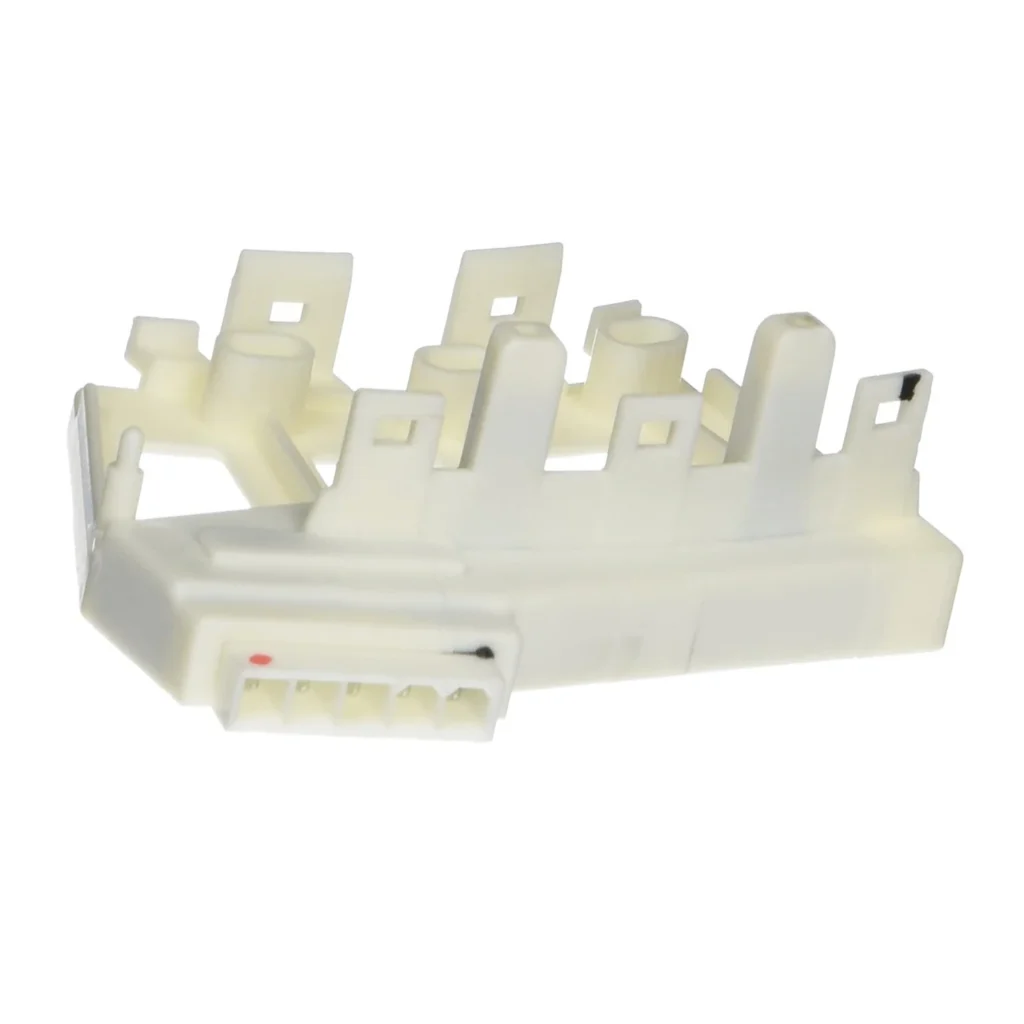
You start a load, the washer fills and agitates normally, but when it's time to spin — nothing. The drum sits there full of soaking wet clothes, and "LE" blinks on the display. You try restarting it. Same thing. The motor hums for a second, then quits, and that LE code comes right back.
This is the most common failure mode on LG front-loaders from the WM2016CW through the WM3575CW and dozens of models in between. The good news? It's usually a $20 sensor, not a $300 motor.
What LE Actually Means
LE stands for "Locked rotor Error" or "motor Error" depending on which LG tech manual you read, but the practical meaning is the same: the motor control board can't figure out where the rotor is positioned, so it won't spin the drum. Think of it like a car's engine losing track of which cylinder should fire next — everything stops.
The motor in your LG washer is a direct-drive unit with no belt. It uses a Hall sensor (rotor position sensor) to tell the control board exactly where the spinning rotor is at any moment. When that sensor fails — from heat, vibration, or the constant magnetic field it sits in — the board goes blind and shuts everything down to prevent damage.
Most Likely Causes (Ranked by Probability)
1. Failed Hall Sensor (Rotor Position Sensor) — High Probability
This is the culprit in about 70% of LE error cases. The sensor itself (part 6501KW2002A/B) is a small electronic component mounted on the stator coil assembly. It wears out from heat cycles and constant exposure to the electromagnetic field. One customer put it simply: "I looked up the error code online and found tons of complaints. Bought the sensor for $17, replaced it in 25 minutes, and the washer works perfectly."
2. Loose or Corroded Wire Harness — Medium Probability
The Hall sensor connects via a small wire harness with a clip-on connector. If this gets bumped during a previous repair, or if moisture causes corrosion on the pins, you'll get an intermittent or permanent LE code. Check this before ordering parts — unplug and replug the connector a few times to see if contact improves.
3. Actual Motor Rotor Obstruction — Low Probability
Something physically jamming the rotor (like a sock wedged between drum and tub, or a failed bearing causing misalignment) can trigger LE. If the drum won't turn freely by hand with the power off, this is your issue. But if it spins smoothly, it's not mechanical — it's the sensor.
4. Failed Stator or Control Board — Low Probability
If the stator coil windings are burned out, or the motor control board itself has failed, you'll also see LE. But these are expensive failures ($150–$400), and they're rare compared to the $20 Hall sensor. Always replace the sensor first.
Step-by-Step Fix
What You'll Need:
- Replacement Hall sensor (6501KW2002A or 6501KW2002B)
- 17 mm socket (not 15 mm — multiple people have made this mistake)
- 10 mm socket
- Phillips screwdriver
- Flat-head screwdriver
- Blue Loctite (medium strength)
- Socket wrench with extension
- Helper (optional but useful for holding the drum)
Step 1: Access the Motor
Unplug the washer and turn off the water. Pull it away from the wall so you can work behind it. Remove the four screws holding the rear access panel (usually Phillips head). Lift the panel off.
Step 2: Remove the Main Rotor Bolt
You'll see a large bolt in the center of the rotor (the spinning part attached to the drum). This is a 17 mm bolt. Have someone reach inside the drum from the front and hold it steady, or wedge a piece of wood between the drum and tub from the top. Loosen the bolt counterclockwise with a socket wrench and extension. Remove the bolt completely, then carefully slide the rotor off the shaft.
Step 3: Remove the Stator Assembly
The stator (the stationary coil pack) is held by six 10 mm bolts arranged in a circle. Remove all six. Disconnect the ground wire (single screw) and unclip the wire harness clamp. Carefully pull the stator assembly straight back off the motor shaft.
Step 4: Replace the Hall Sensor
The Hall sensor is a small black component clipped into the stator coil. Use a flat-head screwdriver to gently release the clip tabs. Pull the old sensor out. Push the new sensor in until it clicks. Make sure the wire harness isn't pinched.
Step 5: Reassemble
Reverse the steps. When you reinstall the rotor bolt, apply blue Loctite to the threads — this bolt vibrates constantly and can back out if you don't. Torque it snug (you don't need a torque wrench, just firm hand-tight with the socket wrench). Reattach the back panel.
Step 6: Reset and Test
Plug the washer back in. Run it empty on a spin cycle. If it still shows LE immediately, try this trick from a user who had success: "I turned on the washer, selected high speed spin, and with the back open I carefully rotated the drum several inches by hand until the Hall sensor made an electrical 'click' and the drum began to function properly." Sometimes the sensor needs to sync position on first startup.
When the Fix Doesn't Work
If you've replaced the Hall sensor, checked all connections, and the drum spins freely by hand but you still get LE, you're looking at one of three things:
- Bad sensor out of the box (rare but happens — contact the parts supplier for a replacement)
- Failed motor control board (the board that interprets the Hall sensor signal). This is a $120–$200 repair.
- Stator coil failure (burned windings). You'll sometimes smell burnt insulation. New stator runs $150–$250.
At that point, you're into $300+ territory. On a 10-year-old machine, it might be replacement time. On a 3–5 year old LG, the repair still makes sense.
Frequently Asked Questions
Can I just reset the washer to clear the LE code?
You can try unplugging for 10 minutes or holding the Start button for 5 seconds to reset, but if the Hall sensor has actually failed, the code will come right back as soon as you try to spin. Resets work for glitches, not hardware failures.
Will the washer work at all with a bad Hall sensor, or is it completely dead?
The washer will usually fill and agitate normally during the wash cycle (low-speed rotation doesn't need precise rotor position). It dies when it tries to spin fast — that's when the control board needs exact position data and realizes the sensor isn't responding.
How long does the Hall sensor typically last on LG washers?
Most failures happen between 5–8 years of regular use. Heavy use (large families, daily loads) can shorten that to 3–4 years. The sensor sits in a harsh environment — heat, vibration, strong magnetic fields — so eventual failure is normal wear, not a design defect.
Before ordering parts, manually rotate the drum with the power off. If it spins smoothly and quietly, the problem is almost always the Hall sensor, not the motor or bearings. If it grinds or won't turn, you have a mechanical issue.
Need the control board or touchpad?
Genuine OEM & aftermarket options in stock