
Samsung Washer Loud Grinding or Won't Spin — Spider Arm Failure & Fix
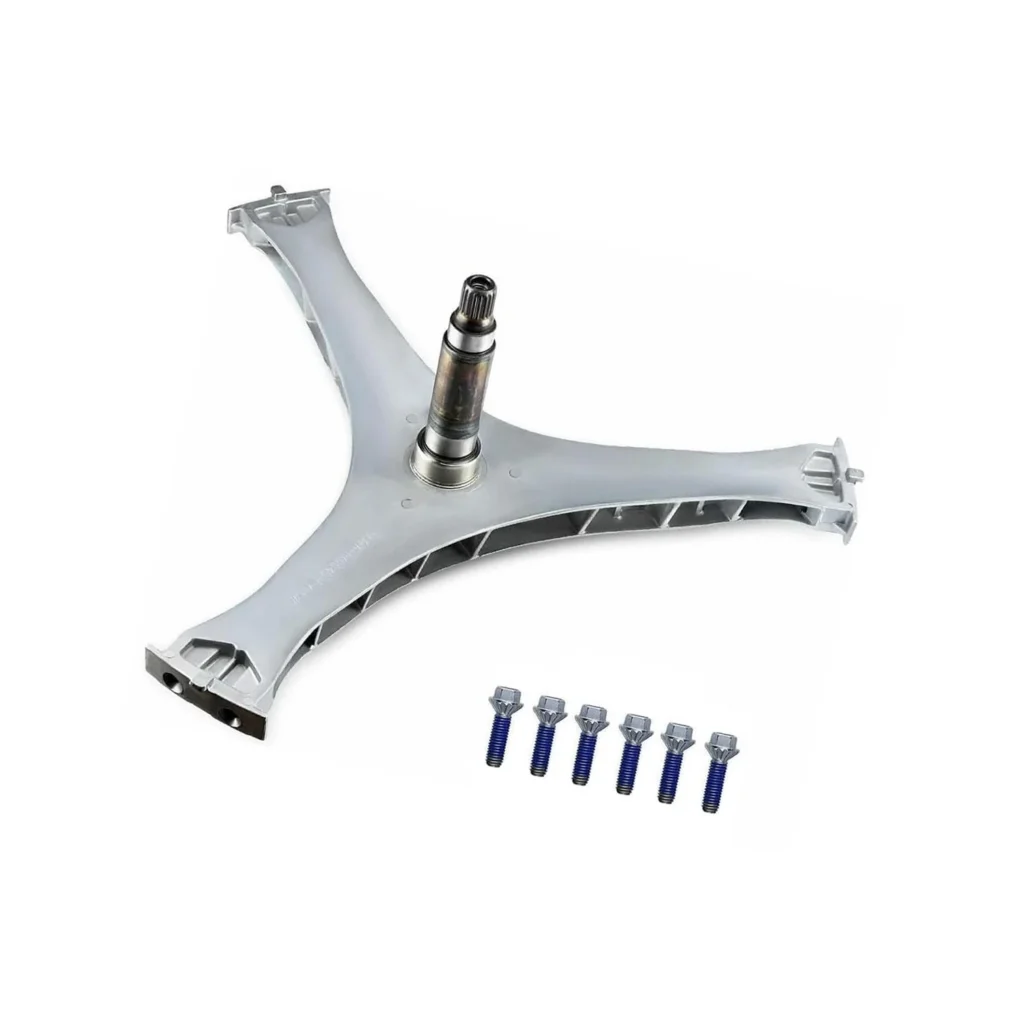
You throw in a load of towels, hit start, and twenty minutes later your Samsung front-loader sounds like it's chewing gravel. The drum barely spins, and there's a metallic scraping that wasn't there last week. You're looking at a classic spider arm failure — one of the most common mid-life failures in Samsung front-load washers, especially models like the WF42H5400AW, WF42H5200AP, and WF395BTPARA series.
The spider arm (also called the flange shaft assembly, part DC97-17004B) is the aluminum bracket that connects your washer drum to the drive shaft. It sits in constant contact with water and detergent, and on Samsung washers built between 2011-2017, it's notorious for corroding from the inside out. When it goes, your washer becomes unusable.
Quick Symptom Check — Is Your Spider Arm Failing?
Check off what you're experiencing:
- Loud grinding or scraping during spin cycle — sounds metallic, gets worse with heavier loads
- Drum wobbles excessively or tilts to one side — you can physically see it's off-center
- Washer won't complete spin cycle — stops mid-cycle with error codes or just quits
- Black or rusty residue on clothes — from corroded aluminum flaking off
- Visible cracks or white powder on spider arm — if you've already pulled the drum, this confirms it
- Error codes: UE, UB, or E4 — unbalanced load errors that persist even with small loads
If you checked three or more, you're almost certainly dealing with spider arm corrosion or complete failure.
Cause #1: Spider Arm Corrosion (85% Probability)
What's happening: The DC97-17004B spider arm is made from cast aluminum. Samsung's design has three arms that bolt to the stainless drum and a center hub that mounts to the shaft. Water and detergent residue seep into the joints between the arm and drum, causing electrochemical corrosion. The aluminum literally disintegrates — you'll see white powdery buildup, deep pitting, or complete fractures through the arms.
Diagnosis: This requires partial disassembly, but you can get strong indicators before tearing everything apart:
- Unplug the washer and pull it away from the wall
- Remove the back service panel (six screws)
- Manually rotate the drum slowly while watching the pulley — does it wobble side-to-side instead of spinning true?
- Grab the drum at 12 o'clock and 6 o'clock and try to rock it front-to-back — excessive play means the spider mounting is compromised
- If you see black dust or aluminum shavings around the tub area, it's already shedding material
Why it happens: Samsung used a design where dissimilar metals (aluminum spider, stainless drum, steel bolts) sit in constant moisture without adequate drainage. Front-loaders seal moisture in by design. Add fabric softener buildup, and you've created a perfect corrosion chamber. Models manufactured before the design revision to DC97-17004C are especially vulnerable.
The fix: There's no patching this. Once corrosion starts, it accelerates. You need to replace the entire spider arm assembly (DC97-17004B or updated DC97-17004E). This is a 3-4 hour job requiring full drum removal, seal replacement, and reassembly. Not a beginner repair, but experienced DIYers can handle it with patience.
Cause #2: Spider Arm Bolt Failure (10% Probability)
What's happening: The spider arm bolts to the drum with three large bolts. If these weren't torqued properly during a previous repair, or if corrosion weakens them, they can shear off. You'll get similar symptoms to full spider failure but the arm itself might still be intact.
Diagnosis: Once you've removed the drum (you have to anyway for spider access), flip it over and inspect the bolt holes. Look for:
- Stripped threads in the drum
- Sheared bolt shanks still stuck in holes
- Elongated bolt holes from movement
- The spider arm itself not showing severe corrosion
The fix: If only the bolts failed and the spider is salvageable, you can re-tap the threads and use new grade-8 bolts with threadlocker. But honestly, if you're this far into disassembly and the spider shows ANY corrosion pitting, replace it now. The labor is identical and you don't want to reassemble only to have the spider fail six months later.
Cause #3: Drum Bearing Failure Mimicking Spider Issues (5% Probability)
What's happening: The main drum bearings (which usually come as a sealed unit with the outer tub on Samsung models) can fail independently. Bad bearings create grinding noise and wobble that looks identical to spider failure.
Diagnosis: With the back panel off:
- Rotate the drum by hand — bearing failure creates a rough, grinding feel throughout the rotation
- Spider arm failure usually has smooth spots and rough spots as the damaged section rotates past
- Check for rust streaks running down the outside of the tub below the bearing seal — that's bearing grease mixed with water leaking out
The reality: On Samsung front-loaders, spider arm failure and bearing failure often happen together. Water that corrodes the spider usually got past the bearing seal first. Most techs replace both as a package — which on many Samsung models means replacing the entire outer tub assembly because the bearings are non-serviceable. That's a $400+ job in parts alone, which is why many of these washers get junked instead of repaired.
The Repair Reality Check
Let's be straight: replacing a spider arm on a Samsung front-loader is one of the most labor-intensive repairs you can do. You're disassembling the entire machine, removing the drum, pressing out the old spider (which might be corroded onto the shaft), cleaning everything, installing the new spider, replacing door seals, and reassembling. It takes 3-5 hours even if you know what you're doing.
Parts you'll need:
- DC97-17004B spider arm assembly: $188.99
- Drum bearing (if replacement is possible on your model): $80-150
- Door boot seal (might as well replace while you're in there): $60-90
- Shaft seal: $15-25
Special tools required:
- Spanner wrench for the drum nut (or you'll fabricate one from a 2x4)
- Penetrating oil (PB Blaster or equivalent)
- Rubber mallet
- Torque wrench for reassembly
- Bearing press or heavy-duty C-clamp setup
Professional repair runs $350-500 in labor plus parts. You're looking at $600-750 total for a washer that's probably worth $400-600 used. This is why spider arm failure is often the death sentence for mid-range front-loaders.
When to Call a Pro (Or Replace the Washer)
Call a professional if:
- You've never disassembled a front-load washer before — this isn't the repair to learn on
- Your washer is under 5 years old and still under extended warranty
- You don't have a solid weekend and workspace to spread parts everywhere
Consider replacement if:
- Your washer is over 8 years old
- It's a lower-end model (WF42H5000AW, WF42H5100AW) where repair cost exceeds replacement value
- You find bearing failure plus spider failure — now you're into $400+ in parts
- The outer tub is cracked (check while you're diagnosing)
The hard truth: Samsung's 2011-2017 front-loaders have a known design flaw with these spider arms. If yours lasted 6-8 years before failing, that's actually typical lifespan. Newer models (2018+) use updated materials, but they don't have a long enough track record yet to know if the problem's truly solved.
Prevention (For Next Time)
If you do repair this or buy another front-loader, extend spider life by:
- Leaving the door cracked open after every cycle — lets moisture evaporate instead of sitting against the spider
- Running a cleaning cycle monthly — reduces detergent buildup that traps moisture
- Using HE detergent in proper amounts — excess suds = excess residue
- Wiping down the door seal weekly — removes standing water
These won't make your spider immortal, but they can push failure from 6 years to 10+ years.
Frequently Asked Questions
Can I just keep using my washer if the spider arm is corroding but still spinning?
For a few weeks, maybe, but I wouldn't. Once you hear grinding, the spider is actively shedding aluminum particles that get on your clothes and into the pump. Worse, when a spider arm fully fractures, the drum can shift and tear through the outer tub, the door boot, or jam into the heating element. That turns a $200 spider repair into a totaled washer. If you're hearing metal-on-metal, stop using it.
Will the updated DC97-17004E spider arm last longer than the original?
Samsung revised the design slightly with better corrosion-resistant coating, but it's still aluminum in a wet environment. Real-world reports suggest maybe 20-30% longer lifespan, but that's hard to quantify since the revised parts haven't been in service for a full decade yet. The fundamental design issue — dissimilar metals in constant moisture — hasn't changed. This isn't a "fix it once and forget it" part.
My Samsung washer shows UE error code constantly — is that always the spider arm?
Not always. UE (unbalanced load) can be caused by failed suspension springs, worn shock absorbers, a loose counterweight, or even something as simple as the washer not sitting level on the floor. Spider arm failure causes UE codes because the wobbling drum can't distribute weight properly, but start with the simpler checks first: verify the washer is level, test the suspension rods for play, and make sure nothing's wedged under the drum. Only tear into spider arm diagnosis if those check out and you're also hearing grinding or seeing excessive wobble.
Diagnosed the problem?
DC97-17004B · In Stock · Fast shipping