
Samsung Washer Won't Start — 5 Door Lock Causes & How to Fix DC34-00025D
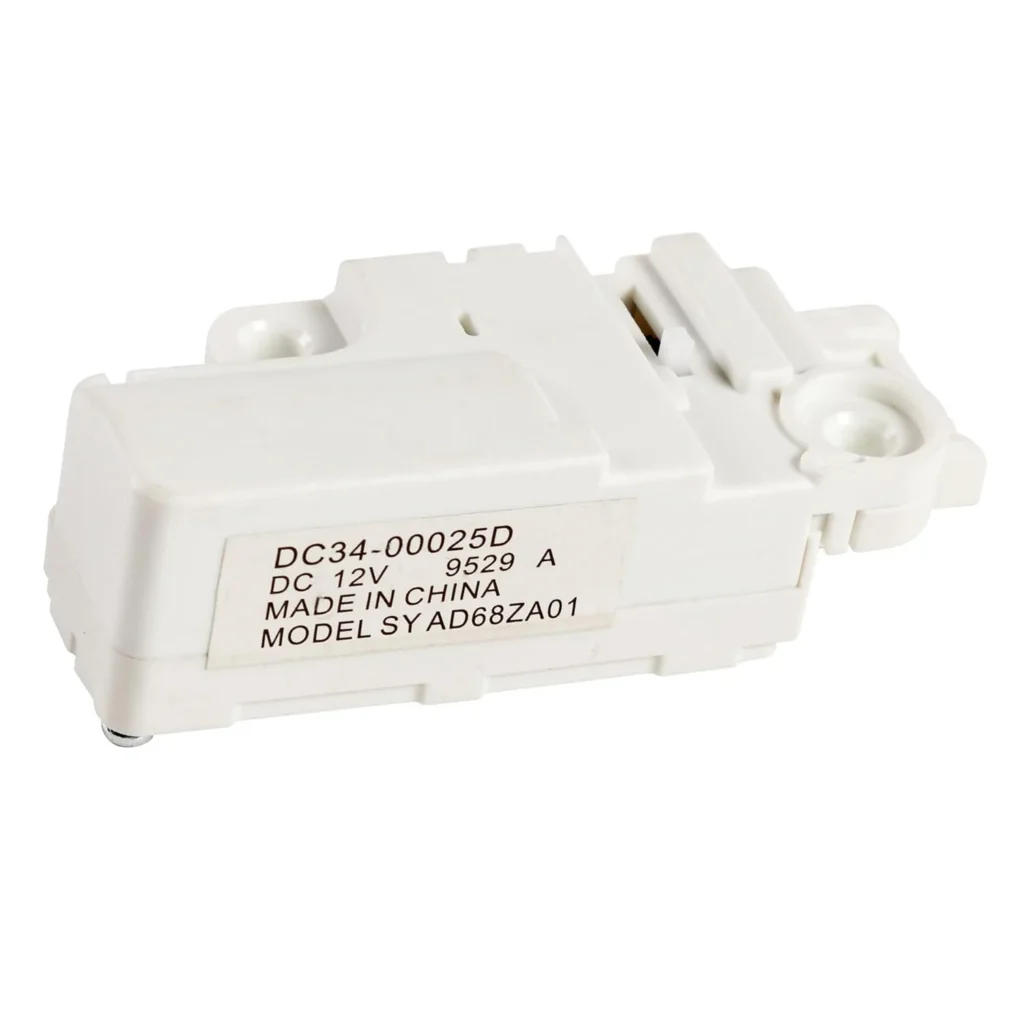
You load the laundry, add detergent, press Start... and nothing. The Samsung washer sits there silent, or maybe you hear a single click followed by absolutely nothing. You press Start again. Still nothing. Check the door — it's closed tight, but somehow your WF45K6200AW won't acknowledge it.
Nine times out of ten, this is the door lock switch calling it quits. The DC34-00025D door lock assembly is what tells your washer "hey, it's safe to fill with water now." When it fails, your machine won't start the cycle because it thinks the door's still open.
Quick Symptom Check
Your Samsung washer has a door lock problem if you're experiencing:
- No response when pressing Start — lights work, controls respond, but cycle won't begin
- Single click then nothing — you hear the lock attempt to engage once, then silence
- Door won't lock at all — you can pull the door open even after pressing Start
- "dE" error code — displayed on WF45K, WF50K, or WW90K models
- Continuous clicking sound — lock trying repeatedly to engage but failing
- Cycle starts then immediately stops — begins to fill, then aborts within 10 seconds
Cause #1: Failed Door Lock Switch Assembly (75% of Cases)
Probability: Very High
The DC34-00025D contains both a mechanical latch and an electronic switch. The mechanical part physically holds the door closed. The electronic part sends a signal to the control board saying "door's locked, proceed with wash." When the electronic switch burns out — which it does after a few thousand cycles — the control board never gets that all-clear signal.
Here's how to test it:
- Unplug the washer completely (wait 60 seconds for capacitors to discharge)
- Open the door and locate the lock assembly on the right side of the door frame
- Remove the two Phillips screws holding the lock in place
- Disconnect the wire harness (squeeze the tab and pull straight out)
- Set your multimeter to continuity mode
- Test between the common terminal and the normally-open terminal
- Manually push the actuator pin in (simulating a closed door)
- You should hear a beep indicating continuity when pressed, no beep when released
No continuity change? The switch is dead. This is especially common on WF45K6500AV, WF50K7500AW, and WW90K74150 models manufactured between 2016-2018.
Fix: Replace with DC34-00025D (also listed as AP6025317 or PS11758871). Takes about 20 minutes. No special tools needed beyond a Phillips screwdriver.
Cause #2: Damaged Door Strike Plate (10% of Cases)
Probability: Moderate
The strike plate is the metal piece on the door itself that engages with the lock. If someone's slammed the door hard repeatedly, or if a heavy item hit the door during shipping, this strike can bend slightly. Just 2mm of misalignment is enough to prevent proper locking.
Check for this:
- Close the door slowly and watch where the strike meets the lock
- Does it slide smoothly into the lock housing, or does it catch?
- Open the door and inspect the strike plate for visible bending or wear marks
- Look for scratches on the strike that indicate it's hitting at the wrong angle
Fix: Sometimes you can carefully bend the strike back into alignment with needle-nose pliers. More often, you'll need to replace the entire door assembly (part number varies by model). If the strike is only slightly off, shimming the lock assembly with a thin washer can restore proper engagement.
Cause #3: Corroded Wire Harness Connection (8% of Cases)
Probability: Moderate (Higher in Humid Climates)
The wire connector that plugs into the door lock sits right behind the front panel where condensation can accumulate. Over time, moisture causes the terminals to corrode. The connection looks fine from the outside, but there's a layer of oxidation preventing proper electrical contact.
This one's sneaky because wiggling the connector might temporarily restore contact, making you think the lock itself is intermittent.
Diagnosis:
- Unplug the washer
- Disconnect the wire harness from the lock
- Inspect both the connector pins and the lock terminals
- Look for green/white corrosion or brown discoloration
- Check inside the plastic connector housing for moisture
Fix: Clean terminals with electrical contact cleaner and a small wire brush. If corrosion is severe, you'll need to cut the connector off and splice in a new one with heat-shrink butt connectors. Apply dielectric grease to prevent future corrosion. This fix costs under $5 if you catch it early.
Cause #4: Control Board Not Sending Lock Signal (5% of Cases)
Probability: Low (But Expensive If True)
Sometimes the door lock is perfectly fine, but the main control board has a failed relay or burned trace that prevents it from sending power to the lock. This typically happens after a power surge or if water has dripped onto the control board.
You'll suspect this if:
- The lock tests good with a multimeter
- Connections are clean and tight
- Manually jumping the lock with 120V makes it engage (dangerous — don't do this unless you know what you're doing)
- Other functions are also glitchy (display flickers, buttons unresponsive)
Fix: Control board replacement runs $150-$300 depending on model. This is where you seriously consider whether repair makes sense versus replacement, especially if the washer is over 7 years old.
Cause #5: Broken Door Hinge Causing Misalignment (2% of Cases)
Probability: Low
Samsung front-load washers have hefty doors. After years of opening and closing, the hinges can develop play or the mounting screws can loosen. This causes the entire door to sag slightly — maybe just 3-4mm — but that's enough to prevent the strike from properly engaging the lock.
You'll notice this if:
- The door doesn't close as smoothly as it used to
- There's a visible gap at the top or bottom of the door seal when closed
- The door feels loose or wobbly when you move it
- You hear the lock click, but the door pops open during the cycle
Fix: First try tightening the hinge screws (they're hidden behind the chrome ring at each hinge). If that doesn't work, the hinge assembly itself needs replacement. The door will need to come completely off, which is a two-person job because these doors weigh 25-30 pounds.
When to Call a Pro
Replacing the DC34-00025D door lock switch is genuinely DIY-friendly. It's four screws, one connector, 20 minutes. You don't need to move the washer or access the back panel.
But call a technician if:
- You've replaced the lock and still have the same problem (likely control board)
- Water is leaking from around the door seal (bigger issue than just the lock)
- The washer is still under warranty (don't void it)
- Multiple error codes are appearing (dE, LE, UE all at once suggests control board failure)
- You're uncomfortable working with the wiring
A service call for door lock diagnosis typically runs $90-$150. Replacement labor adds another $80-$120, so you're looking at $170-$270 total. The part itself is $35-$50. DIY saves you about $135-$220.
Frequently Asked Questions
Can I bypass the door lock to test if my washer works?
Technically yes — you can jump the lock circuit to fool the control board — but absolutely don't. Samsung washers spin at 1200+ RPM. An unlocked door during spin cycle can cause serious injury or property damage. Always repair the lock properly. If you need to test whether the lock is the only problem, manually lock the door with the latch removed and use a multimeter to simulate the switch signal to the control board.
Why does my Samsung washer lock but won't unlock after the cycle?
That's actually a different failure mode of the same DC34-00025D part. The lock mechanism has a bi-metal strip that's supposed to cool and release after the cycle. When this strip fails, it stays energized and keeps the door locked. Unplug the washer for 10 minutes to allow it to cool and release. If it happens repeatedly, replace the lock assembly — the bi-metal strip can't be serviced separately.
Will a door lock from a different Samsung model work in my WF45K6200AW?
Maybe, but probably not worth the risk. Samsung uses different lock assemblies across model lines even though they look similar. The DC34-00025D is specifically engineered for WF45K, WF50K, and WW90K series washers with the updated wire harness (the one with 6 pins instead of 4). Using the wrong part might physically fit but could cause intermittent issues or error codes. Stick with the correct part number — it's designed for your specific control board voltage and timing requirements.
Diagnosed the problem?
DC34-00025D · In Stock · Fast shipping