
LG Dryer Won't Heat Up — 5 Causes & How to Fix It
You toss a load of wet towels into your LG dryer, set it to high heat, and come back 60 minutes later to find everything still damp. The drum's spinning fine, but there's no warmth at all. This is one of the most common — and most frustrating — dryer failures, and the culprit is usually hiding in your heating system.
The good news? Most no-heat issues on LG dryers like the DLEX3001W, DLE5955W, or DLEX3875V trace back to a handful of testable components. We'll walk through each one in order of likelihood, so you can diagnose this yourself before spending money on a service call.
Quick Symptom Check
Before you grab your multimeter, confirm you're dealing with a heating issue and not something else:
- Drum spins normally — motor and belt are fine
- No heat at all — not even lukewarm air
- Clothes come out damp after a full cycle
- No burning smell — that's a different problem
- Vent airflow feels normal — not a clog issue
If that matches your situation, you're looking at a failed component in the heating circuit. Let's narrow it down.
Cause #1: Blown Hi-Limit Thermostat (Most Common — 40% of Cases)
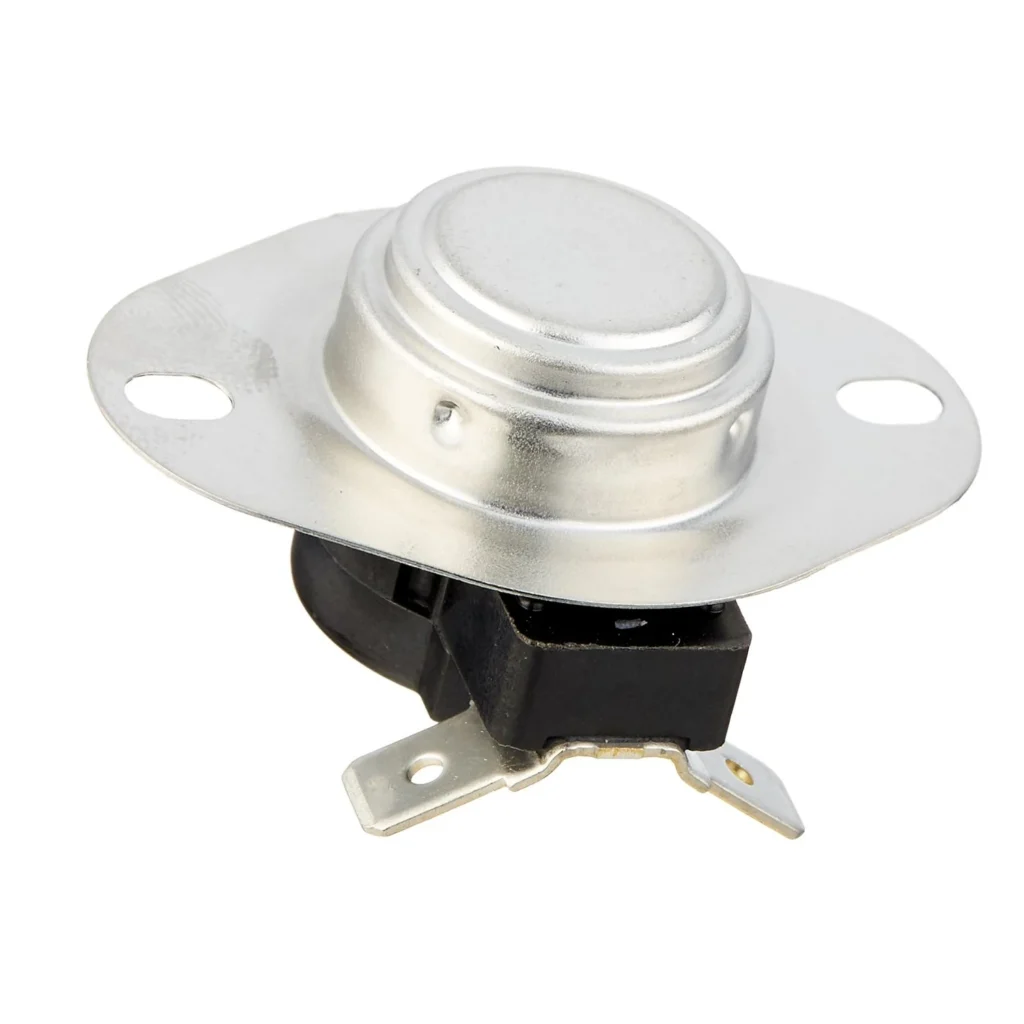
The hi-limit thermostat (part number 6931EL3001F) is a one-shot safety device mounted on the heating element housing. When your dryer overheats — usually from a clogged vent or blocked blower wheel — this thermostat trips permanently at around 280°F to prevent fires.
Here's the tricky part: once it blows, it doesn't reset. Your dryer will run perfectly fine, but the heating circuit stays open forever. You'll never get heat again until you replace it.
How to test it:
- Unplug the dryer and pull it away from the wall
- Remove the lower front panel (two screws at the bottom)
- Locate the heating element canister on the right side
- Find the white disc-shaped thermostat with two wire terminals
- Disconnect the wires and test continuity with a multimeter
- You should get a reading of 0 ohms (continuous circuit)
- If it reads infinite resistance (OL), it's blown
Probability: If your vent system isn't cleaned regularly, this is your problem. The 6931EL3001F replacement runs about $41 and takes 20 minutes to install.
Important: If this thermostat failed, something caused it to overheat. Clean your entire vent system thoroughly before replacing the part, or the new thermostat will blow again in a few weeks.
Cause #2: Faulty Heating Element (30% of Cases)
The heating element itself can burn out or break internally. On LG dryers, the element consists of a coiled wire inside a metal housing. Over time, the coil can develop breaks or short to the housing.
How to test it:
- With the front panel still off, locate the heating element canister
- Disconnect all wire terminals from the element
- Test continuity between the two element terminals — should read 8–12 ohms
- Test from each terminal to the metal housing — should read infinite (no continuity)
- If you get continuity to the housing, the element is shorted and must be replaced
What you'll see: A broken element shows infinite resistance between terminals. A shorted element shows continuity to ground.
Cost: Heating elements run $50–$90 depending on your model. Installation takes about 30 minutes if you're comfortable with the disassembly.
Cause #3: Bad Thermal Fuse (20% of Cases)
The thermal fuse is another one-time safety that's usually mounted on the blower housing or heating element assembly. It blows at around 250°F if airflow drops too low.
Key difference from the hi-limit: When the thermal fuse blows, your dryer often won't start at all — no heat, no tumbling, nothing. But on some LG models, it only kills the heating circuit.
How to test it:
- Locate the thermal fuse (consult your model's diagram — location varies)
- Disconnect the two wire terminals
- Test continuity — should read 0 ohms
- If it's open (infinite resistance), it's blown
Prevention: Same as the hi-limit — clean your vents. A $8 thermal fuse fails because of a $0 maintenance issue.
Cause #4: Defective Cycling Thermostat (7% of Cases)
The cycling thermostat regulates temperature during the dry cycle by switching the heating element on and off. If it fails in the open position, you'll get no heat. If it fails closed, you'll get too much heat (which eventually blows your hi-limit).
How to test it:
- Locate the cycling thermostat on the blower housing
- At room temperature, it should show continuity (closed)
- You can't reliably test it hot without running the dryer
- If your hi-limit and element test fine, replace the cycling thermostat
Cost: About $20–$35. This is a trial-and-error diagnosis if all other components check out.
Cause #5: Wiring or Control Board Issue (3% of Cases)
If every thermal component tests fine, you might have a wiring problem or a failed control board that's not sending voltage to the heating circuit.
How to check:
- With the dryer running (on heat setting), use a voltmeter to test for 120V at the heating element terminals
- If voltage is present but there's no heat, the element or thermostat is bad despite testing OK
- If there's no voltage, trace the wiring back to the control board
Reality check: Control board failures are rare on LG dryers. Don't replace a $200 board until you've confirmed every other component.
When to Call a Pro
Here's my honest take: if you're comfortable using a multimeter and removing a few screws, this is a DIY repair. The components are cheap, the disassembly is straightforward, and you'll save $150–$250 in labor.
Call a tech if:
- You're not comfortable working with electrical testing
- Your dryer is still under warranty
- You've replaced the hi-limit and element but still have no heat
- You find damaged or melted wiring
One warning: gas dryers have the same electrical heating circuit issues, but they also have gas valve coils and igniters that can fail. If you have a gas model, the troubleshooting is more complex.
Frequently Asked Questions
Can I bypass the hi-limit thermostat temporarily to test if that's the problem?
Technically yes — you can jumper the two terminals to close the circuit — but don't run the dryer this way for more than a test cycle. The hi-limit exists to prevent fires. If it blew once, your dryer can overheat again, and without that safety you're risking a real fire hazard. Use this only to confirm diagnosis, then install a proper replacement.
Why does my hi-limit thermostat keep blowing every few months?
You've got an airflow restriction somewhere. Check these in order: lint screen (obvious), vent hose behind the dryer (crushed or kinked?), exterior vent flap (clogged with lint or stuck closed?), and the blower wheel inside the dryer (packed with lint). If airflow is restricted, the heating chamber hits 280°F and the hi-limit sacrifices itself to protect your house. Fix the root cause or you'll keep replacing $41 thermostats forever.
Do I need to replace both the hi-limit and the thermal fuse at the same time?
Only if both tested bad. They're independent components. That said, if your hi-limit blew from overheating, there's a chance the thermal fuse did too — they blow at similar temperatures. Test them both while you've got the panel off. If both are open, replace both. And for the love of all things holy, clean your vent system before you button everything back up.
Diagnosed the problem?
6931EL3001F · In Stock · Fast shipping