
LG Dryer Not Heating or Takes Forever to Dry — 5 Causes & How to Fix
You toss a load of towels in your LG dryer, set it for 60 minutes, and come back to find everything still damp. You run it again. Still damp. By the third cycle, you're hanging wet laundry around your house like it's 1950.
Here's the thing — when an LG dryer won't heat properly or takes multiple cycles to dry a single load, you're usually looking at one of five specific failures. And the most common culprit? A faulty thermistor assembly that's lying to your dryer's control board about the actual temperature inside the drum.
Let's walk through exactly how to diagnose what's wrong with your dryer, starting with the quickest checks first.
Quick Symptom Check
Before you grab any tools, confirm what's actually happening:
- Clothes come out damp or cold — dryer runs full cycle but produces zero heat
- Takes 2-3 cycles to dry one load — dryer heats somewhat but not enough
- Dryer stops mid-cycle repeatedly — safety cutoffs triggering due to false temperature readings
- Error codes on display — tE1, tE2, or similar temperature sensor errors
- Dryer runs extremely hot — thermistor stuck reading cold, so heating element stays on continuously
Got one or more of these? You're in the right place.
Cause #1: Failed Thermistor Assembly (Most Likely)
Probability: 65%
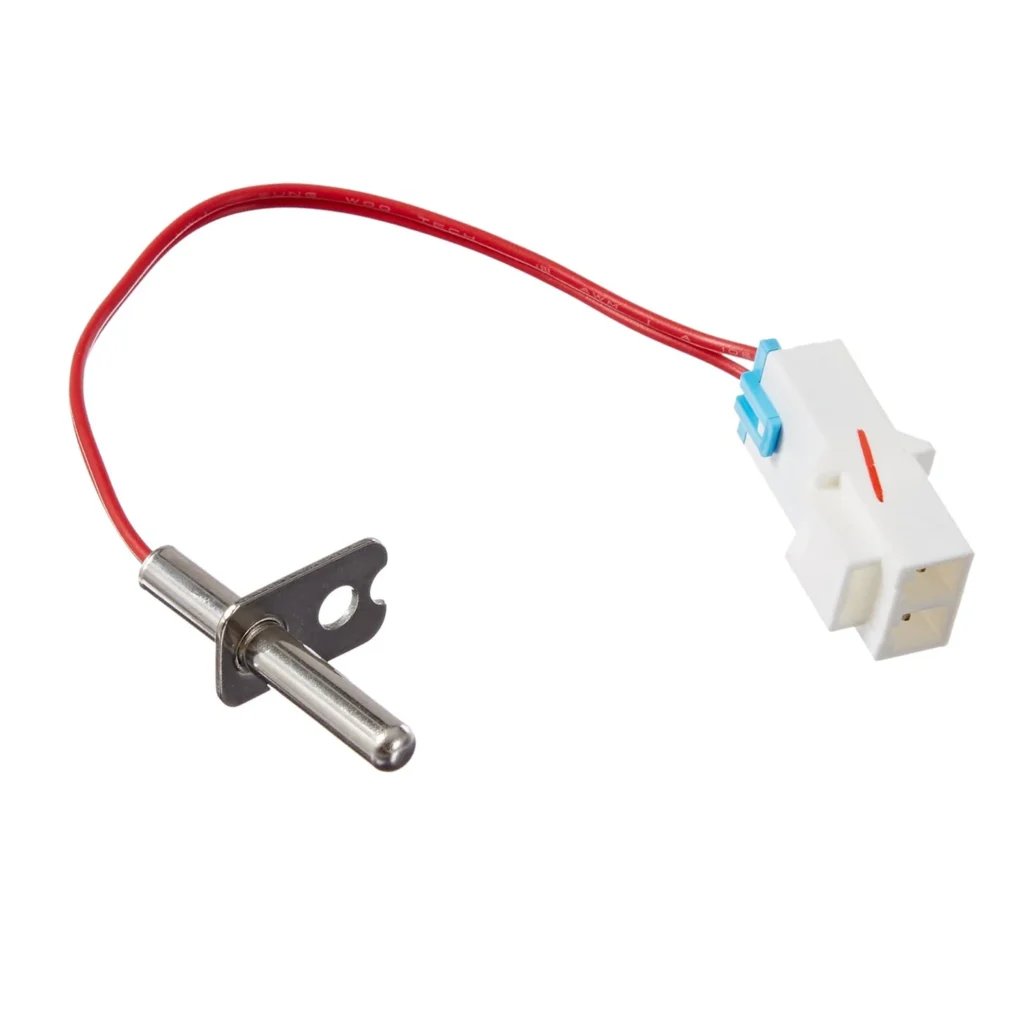
The thermistor (part 6323EL2001B) is a temperature sensor mounted on your dryer's heating duct. It tells the control board how hot the air is so the board knows when to cycle the heating element on and off. When it fails, your dryer's essentially flying blind.
Here's what happens: lint and debris build up around the thermistor over months of use. This insulates the sensor from the actual air temperature. The thermistor sends bad data to the control board — usually reading colder than reality — so either the heating element never kicks on, or it runs non-stop trying to reach a temperature the faulty sensor says it hasn't hit yet.
How to test it:
- Unplug the dryer completely
- Access the thermistor on the heating duct (usually behind the lower front panel on LG models like the DLE5955W, DLEX7177WM, or DLE2512W)
- Disconnect the wire harness from the thermistor
- Use a multimeter set to resistance (ohms)
- At room temperature (around 70°F), you should read approximately 10,000 ohms
- If you get infinite resistance (OL on your meter) or zero ohms, it's toast
Even if it tests okay at room temp, thermistors often fail under heat. If everything else checks out, replace it anyway — it's a $15 part.
Cause #2: Clogged Lint Screen or Exhaust Vent
Probability: 20%
Sometimes the thermistor itself is fine, but restricted airflow makes the dryer overheat, triggering safety cutoffs that stop the heating element. Your dryer runs, but it keeps shutting off heat to protect itself.
Pull out your lint screen. Now look at the cavity where it sits — shine a flashlight in there. See lint buildup along the edges? That's your problem. Even worse, check your exterior vent. Go outside and feel the airflow while the dryer's running. Should be strong and hot. If it's weak, your vent's clogged.
Quick fix: Clean the lint screen housing with a vacuum attachment, then disconnect and clean out your entire vent run. You'd be shocked how much lint accumulates in flexible duct sections.
Cause #3: Defective Heating Element
Probability: 10%
The heating element can fail partially or completely. When it fails completely, you get zero heat no matter what. Partial failures are trickier — the element works intermittently, giving you weak, inconsistent heat.
Test it: Disconnect power, locate the heating element housing (cylindrical assembly behind the drum), disconnect the wires, and test for continuity. You should read 10-50 ohms. Infinite resistance means the coil's broken. Also inspect visually — if you see any breaks or touching coils, replace it.
Cause #4: Faulty High-Limit Thermostat
Probability: 3%
The high-limit thermostat is a safety device that cuts power to the heating element if temps get too high. When it fails in the open position, your heating element never gets power. It's mounted on the heating element housing, usually alongside the thermistor.
Test for continuity — should read near zero ohms (closed circuit) at room temperature. No continuity? Replace it. These rarely fail unless you've had serious overheating issues from blocked vents.
Cause #5: Control Board Misreading Thermistor Signal
Probability: 2%
Least common, but it happens — the main control board develops a fault in the circuit that reads the thermistor. You'll have a perfectly good thermistor sending correct resistance values, but the board interprets the signal wrong.
Only diagnose this after you've confirmed the thermistor, wiring, and all thermal cutoffs are good. Usually comes with other weird symptoms like display glitches or multiple functions acting up simultaneously.
When to Call a Pro
Replacing a thermistor is genuinely DIY-friendly if you're comfortable with basic tools. You'll need a screwdriver, maybe a nut driver, and 30 minutes. The part costs $12-20.
Call a tech if:
- You're getting error codes even after replacing the thermistor
- The heating element tests bad (replacement requires more disassembly)
- You've tested everything and still can't find the fault
- Your dryer's still under warranty
Expect to pay $150-250 for a service call plus parts if you go the pro route.
Frequently Asked Questions
Can I run my LG dryer if the thermistor is bad?
You can, but you shouldn't. A failed thermistor means your dryer can't regulate temperature properly. It might overheat and damage clothes, or it might never heat at all and just waste electricity tumbling damp laundry. Worse, if it's reading cold when the dryer's actually hot, you risk overheating the motor or burning out the heating element. Replace it before running another load.
How long does an LG dryer thermistor typically last?
Under normal conditions, 8-12 years. But that assumes you're cleaning your lint filter every load and deep-cleaning your vent system annually. Heavy use, poor ventilation, or lint buildup can kill a thermistor in 3-5 years. The buildup insulates the sensor from accurate temperature readings, causing it to send bad data until it eventually fails completely.
Will a bad thermistor trigger an error code on my LG dryer?
Usually yes, but not always. Models with digital displays (like the DLEX7177WM or DLE8377WM) typically show tE1 or tE2 error codes when they detect thermistor issues. Older models without fancy displays just act weird — stopping mid-cycle, not heating, or overheating with no warning code. If you've got a code, lucky you — at least you know where to start.
Diagnosed the problem?
6323EL2001B · In Stock · Fast shipping