
Samsung Refrigerator Freezer Fan Not Running — 7 Causes & How to Fix
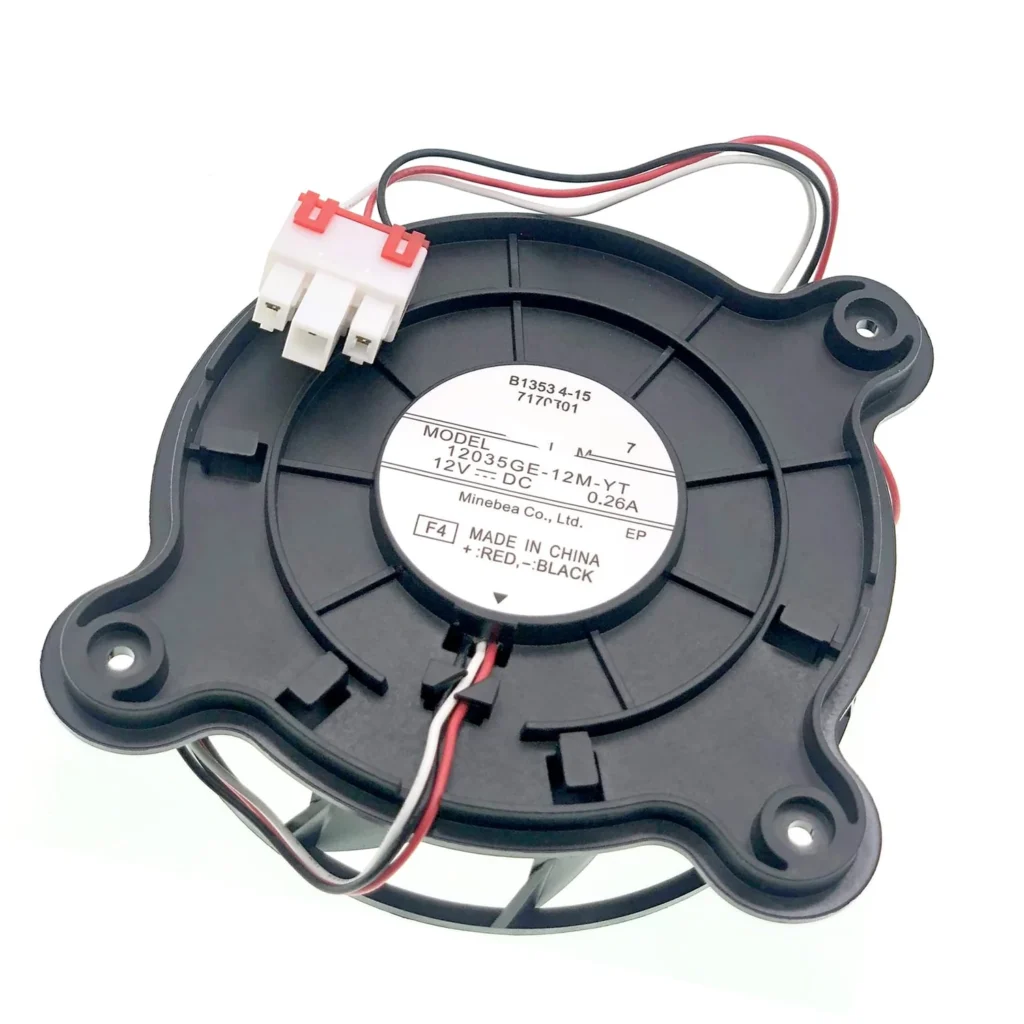
You walk up to your Samsung fridge at 2 AM because you heard it cycling louder than usual. Pop open the freezer door and — silence. No familiar hum from the evaporator fan. Ice cream's soft, frost is building on the back wall, and your refrigerator section feels warmer than it should. If the freezer fan isn't spinning, your whole cooling system breaks down fast.
The evaporator fan motor (part 12035GE-12M-YT, replaces DA31-00334C, DA31-00334A, DA31-00287B, DA96-00968A) circulates cold air from the evaporator coils throughout both compartments. When it fails, the freezer might stay cold briefly, but the fresh food section warms up within 6-12 hours. Let's diagnose why your fan stopped and what you can do about it.
Quick Symptom Check
- No air movement when you hold your hand near the vents inside the freezer
- Fresh food section warming up (36°F climbing to 45°F+) while freezer stays coldish
- Frost buildup on the back wall of the freezer compartment
- Refrigerator running constantly without reaching set temperature
- Clicking or buzzing sound from behind the freezer panel (attempted motor start)
- Food in the fridge section spoiling faster than normal
Cause #1: Failed Evaporator Fan Motor (60% Probability)
This is the most common culprit. The motor bearings wear out after 5-8 years of constant operation, or the windings burn out. On models like the RF23J9011SR, RS25H5111SR, and RF28K9380SG, these motors run 24/7 in harsh sub-zero conditions.
How to diagnose: Open the freezer door and listen carefully. Press the door switch (usually on the right side) to trick the fridge into thinking the door is closed. On Samsung models, the fan should start within 10 seconds. If you hear nothing, or hear clicking without the fan spinning, the motor's likely dead.
Remove the back panel inside the freezer (usually 4-6 screws). Try spinning the fan blade manually. It should rotate freely with slight resistance. If it's frozen solid or won't budge, the motor bearings seized. If it spins freely but won't start electrically, the windings are shot.
The fix: Replace the motor. The 12035GE-12M-YT is a direct-fit replacement. Cost runs $35-55 for the part. Expect 45-60 minutes for the repair if you're comfortable with basic tools.
Cause #2: Ice Buildup Blocking the Fan Blade (25% Probability)
Humid air sneaks into the freezer compartment through a worn door seal or from frequent door openings. That moisture freezes around the evaporator coils and fan blade, physically stopping it from spinning.
How to diagnose: Remove the freezer's back panel. You'll see the evaporator coils and fan. If there's a solid block of ice encasing the fan blade or the coils are completely frosted over (instead of having light, even frost), that's your problem.
This happens more often on RS25J500DSR and RF220NCTASR models with side-by-side configurations — more door openings mean more humid air infiltration.
The fix: Unplug the fridge and let it defrost for 6-8 hours with towels on the floor. Once melted, check the door gasket for tears or gaps. Close the door on a dollar bill — if you can pull it out easily, the seal's weak. Replace the gasket if needed ($40-80). If the defrost system isn't working properly, ice will return within weeks.
Cause #3: Defrost System Malfunction (10% Probability)
Your Samsung runs a defrost cycle every 8-12 hours to melt accumulated frost off the evaporator coils. If the defrost heater, defrost thermostat, or defrost control board fails, frost builds up until it blocks the fan.
How to diagnose: If you've repeatedly defrosted the fridge manually but ice returns within 3-5 days, the automatic defrost system isn't working. With the back panel off, locate the defrost heater (glass tube beneath the coils) and defrost thermostat (small disc with two wires, attached to the coils).
Use a multimeter to test continuity on both. The heater should show 20-50 ohms. The thermostat should show continuity when cold (below 32°F) and open circuit when warm.
The fix: Replace the failed component. Defrost heaters run $25-45, thermostats $15-25. If the control board's bad (rare), you're looking at $150-200 plus labor.
Cause #4: Faulty Door Switch (3% Probability)
The door switch tells the fan to stop when you open the door (so you don't get blasted with cold air). If it's stuck in the "open" position, the fan never runs even with the door closed.
How to diagnose: Locate the door switch on the right side of the freezer opening. Press it manually with the door open. You should hear a click. Use a multimeter to check continuity — it should show closed circuit when pressed, open when released.
The fix: Replace the switch. Part costs $10-20. Takes 5 minutes with a screwdriver.
Cause #5: Wiring Connection Issues (1% Probability)
Vibration over years can loosen the wire harness connections to the fan motor. Rodents occasionally chew wires in garages or basements.
How to diagnose: With the back panel removed, inspect the wire connector plugged into the fan motor. Wiggle it gently while watching for the fan to start/stop. Check for burn marks, corrosion, or damaged wires.
The fix: Reconnect or repair the harness. If wires are damaged, you might need to splice in new wire ($5 in materials) or replace the entire harness ($30-50).
Cause #6: Main Control Board Failure (0.5% Probability)
The main control board sends power to the evaporator fan motor. If the board's relay burns out, the motor gets no power even though it's perfectly functional.
How to diagnose: This is a process-of-elimination diagnosis. If you've verified the motor works (tested with direct 12V power), all wiring is good, and the door switch works, but the fan still won't run during normal operation, suspect the board.
The fix: Main control board replacement runs $200-400 for the part, plus $150-250 labor if you hire someone. Not a DIY-friendly job for most people.
Cause #7: Fan Blade Obstruction (0.5% Probability)
Something physically blocking the fan — a chunk of ice that broke off, food wrapper that got sucked into the vent, or manufacturing debris.
How to diagnose: Visual inspection with the back panel removed. Spin the blade by hand and watch for anything catching.
The fix: Remove the obstruction. If the fan blade itself is damaged (cracked or warped), replace it. Replacement blades cost $8-15.
When to Call a Pro
If you're not comfortable working with electrical components or removing refrigerator panels, call a tech. Expect to pay $150-250 for a service call plus parts. The job typically takes a pro 30-45 minutes.
That said, replacing the evaporator fan motor is genuinely one of the easier refrigerator repairs. If you can handle a screwdriver and follow safety protocols (unplug first!), you'll save $100-150 in labor doing it yourself.
One warning: if your Samsung is still under warranty and you DIY the repair, you might void coverage. Check your warranty status before touching anything.
Frequently Asked Questions
How long does a Samsung evaporator fan motor typically last?
Most original Samsung evaporator fan motors last 5-10 years depending on usage patterns. If you open the freezer door constantly or live in a humid climate, expect the lower end of that range. The 12035GE-12M-YT replacement motor is rated for similar longevity. Models like the RF34H9960S4 and RF28K9580SG with larger capacities may see slightly longer motor life due to less frequent cycling.
Can I run my Samsung refrigerator without the evaporator fan working?
Not advisable for more than 24 hours. The freezer compartment might maintain temperature temporarily, but the fresh food section will warm up quickly since it relies on the fan to circulate cold air from the freezer. You risk losing everything in the fridge section within a day. Plus, running without the fan can cause the compressor to overwork and fail prematurely — that's a $400-800 repair instead of a $50 fan motor.
What's the difference between the evaporator fan and the condenser fan?
The evaporator fan (what we're discussing here — part 12035GE-12M-YT) lives inside the freezer compartment behind the back panel. It circulates cold air throughout the fridge. The condenser fan is underneath or behind the refrigerator near the compressor, cooling the condenser coils. If the condenser fan fails, the whole unit overheats. If the evaporator fan fails, you lose cooling circulation but the compressor keeps running.
Diagnosed the problem?
12035GE-12M-YT · In Stock · Fast shipping