
Maytag Dryer Not Heating or Overheating — 5 Causes & How to Fix
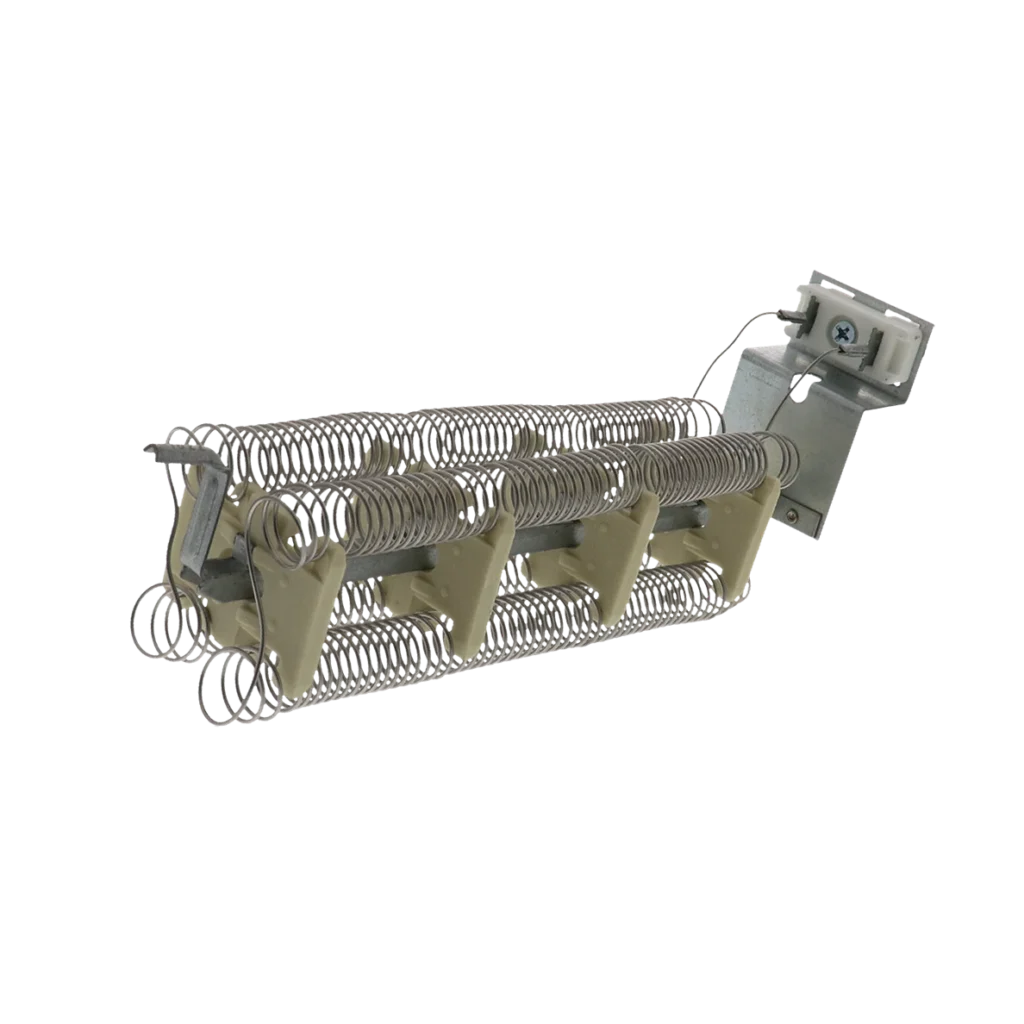
Your Maytag dryer's been running for 90 minutes, and when you open the door, the clothes are still cold and damp. Or maybe the opposite problem — you're pulling out a load that's scorching hot with a burned smell. Both issues often point to the same component: the heating element. When a 240V heating element like the LA-1044 starts failing, it doesn't always quit completely. Sometimes it develops hot spots, breaks partially, or shorts against the housing, causing erratic heating that'll drive you nuts.
Models like the PYET344AYW, PYE2300AYW, and PYE4500AYW use this 4750-watt heating element, and when it goes, you'll know. Let's walk through what's actually wrong.
Quick Symptom Check
Before you start taking things apart, confirm what you're dealing with:
- Drum spins normally, but zero heat — element's completely broken
- Takes 2-3 cycles to dry a normal load — partial element failure or weak heating
- Clothes come out scorching hot — thermostat failure or shorted element
- Burning smell when running — element touching housing or insulation breakdown
- Intermittent heating, works sometimes — loose connection or cracked coil
If you're getting zero heat with normal drum rotation, you're probably 80% likely looking at a dead heating element. But let's check the other possibilities first.
Cause #1: Broken Heating Element (Most Likely — 70% of Cases)
The heating element is a coiled wire that glows red-hot inside a metal housing. Over time — we're talking thousands of heat cycles — the metal fatigues and breaks. When it breaks, the circuit's open, and you get zero heat. Simple as that.
How to diagnose:
- Unplug the dryer (seriously, 240V will ruin your day)
- Remove the lower front panel or rear access panel depending on your model
- Locate the heating element housing — it's a rectangular metal box with wires
- Disconnect the wires and use a multimeter set to ohms
- Test across the element terminals — you should see 10-15 ohms of resistance
- If you read infinite resistance (OL), the element's broken
On models like the PYET244AYW and LNC7760A71, the element's usually accessible from the front after removing the lower panel. Admiral models like the ADE7000AYW typically require rear access.
The fix: Replace with the LA-1044 kit. It's a direct swap — remove four screws, swap the element, reconnect the wires. Budget 45 minutes if you've never done it before.
Cause #2: Blown Thermal Fuse (20% of Cases)
Here's the tricky part — if your dryer's not heating, it might not be the element at all. The thermal fuse is a one-time safety device that blows if the dryer overheats. Once it blows, the heating circuit's dead until you replace it.
Why it blows: Usually restricted airflow. Lint buildup in the vent, crushed ductwork, or a clogged lint screen forces the dryer to run hotter than designed. The thermal fuse sacrifices itself to prevent a fire.
How to diagnose:
- Locate the thermal fuse — it's usually on the blower housing or element housing
- Disconnect it and test continuity with your multimeter
- Should read zero ohms (continuous circuit)
- If it reads infinite, the fuse is blown
Critical: Don't just replace the fuse. If you don't fix the airflow problem, the new fuse will blow in a week. Clean your entire vent system, check for kinks, and make sure the outdoor vent flap opens freely.
Cause #3: Failed High-Limit Thermostat (15% of Cases)
The high-limit thermostat is another safety device, but unlike the thermal fuse, it's supposed to reset. It cuts power to the element if temps exceed about 250°F, then reconnects when things cool down. When it fails, it either stays open (no heat) or stays closed (overheating).
Testing process:
- Find it on the element housing or blower — looks like a small disc with two wires
- At room temperature, it should show continuity (zero ohms)
- If it's open at room temp, it's stuck and needs replacement
If your dryer's overheating rather than not heating, a stuck-closed high-limit is a prime suspect. The element keeps firing without regulation, and you'll smell that burning cotton smell real quick.
Cause #4: Faulty Cycling Thermostat (10% of Cases)
The cycling thermostat actually controls normal operation — it cycles the element on and off to maintain the selected temperature. When it fails, you might get intermittent heating or clothes that come out damp even though the dryer's warm.
This one's trickier to diagnose because it should open and close based on temperature. At room temp, it might read open, which is normal. You really need to test it under operating conditions, which means a bit more involved troubleshooting.
Symptoms pointing to cycling thermostat:
- Dryer heats for a few minutes, then stops, then starts again randomly
- Some cycles heat fine, others don't
- Temperature setting doesn't seem to change anything
Cause #5: Timer or Control Board Issue (5% of Cases)
Least likely, but possible — the timer or electronic control board stops sending voltage to the heating element. You'd still hear the motor running and the drum turning, but no heat.
Check for 240V at the element terminals while the dryer's running. If you've got voltage but no heat, the element's bad. If you've got no voltage and all the thermostats test good, you're looking at a control problem.
Honestly, on older Maytag, Amana, and Admiral dryers, this is rare. These machines are pretty bulletproof from a control standpoint.
The Overheating Problem
Now let's talk about the opposite scenario — your dryer's too hot. Clothes coming out stiff, that burned smell, maybe even scorch marks.
Most common cause: The element's partially shorted against the metal housing. When the coil breaks and touches the case, it can create a direct short that bypasses the thermostats. You get full 240V power with no regulation.
Another possibility: the cycling thermostat's stuck closed, so the element never shuts off. The dryer just keeps heating until the high-limit kicks in, if it's working.
Check this immediately: If your dryer's overheating, check the vent system first. A restricted vent will cause overheating even with a perfectly good element. The hot air can't escape, so it recirculates and keeps getting hotter.
When to Call a Pro
Look, replacing a heating element isn't complicated, but you're working with 240V power. If you're not comfortable with electrical work, call someone. If you've replaced the element and all the thermostats and you're still not getting heat, there's likely a wiring issue or control board problem that needs deeper diagnosis.
Also call a pro if you're dealing with gas dryer issues — this guide's specifically for electric dryers using the LA-1044 element.
Parts You Might Need
If you're doing this yourself, order these together:
- LA-1044 Heating Element — the main part ($54.99)
- Thermal fuse — cheap insurance, replace it while you're in there ($8-12)
- High-limit thermostat — often comes in a kit with the thermal fuse ($10-15)
The LA-1044 works across Maytag, Whirlpool, Admiral, Amana, and Magic Chef models. Check your model number against the compatibility list, but if you've got a model starting with PYE or PYET, you're good.
Frequently Asked Questions
Can a heating element be partially broken and still work sometimes?
Yeah, absolutely. The element coil can develop a crack that makes intermittent contact. When the dryer vibrates or heats up, the broken ends might touch and complete the circuit temporarily. Then they separate again and the heat stops. It's maddening to troubleshoot because it works when you're testing it, then fails during normal use. If you're getting intermittent heating, just replace the element. Trying to track down an intermittent break isn't worth your time.
Why does my Maytag dryer heating element keep burning out?
If you've replaced the element more than once in two years, you've got an underlying problem. Most common: restricted airflow from a clogged vent. The element runs hotter than designed, metal fatigues faster, and it fails prematurely. Second cause: voltage issues. If you're getting more than 240V at the outlet (some areas run 245-250V), the element runs hotter and dies sooner. Third possibility: you're overloading the dryer, which makes it run longer cycles and accumulates more heat stress. Clean your vents, check your voltage, and don't pack the drum.
How do I know if the problem is the heating element or the thermal fuse?
Test both. The thermal fuse is a 30-second test with a multimeter — should show continuity (zero ohms). The heating element should show 10-15 ohms of resistance. If the thermal fuse is blown, you found one problem, but check the element anyway. Sometimes the element breaks first, causes the dryer to run forever trying to heat, and that extended runtime blows the thermal fuse. Replace both and fix your vent system.
Diagnosed the problem?
LA-1044 · In Stock · Fast shipping