
Whirlpool Dryer Making Grinding Noise or Drum Won't Spin — 4 Causes & Fixes
Your Whirlpool dryer starts up with a loud squealing or grinding sound that wasn't there yesterday. Or maybe it hums like it's trying to run, but the drum just sits there — clothes bunched up, going nowhere. You open the door, spin the drum by hand, and it feels smooth enough. Close the door, hit start, and... same problem.
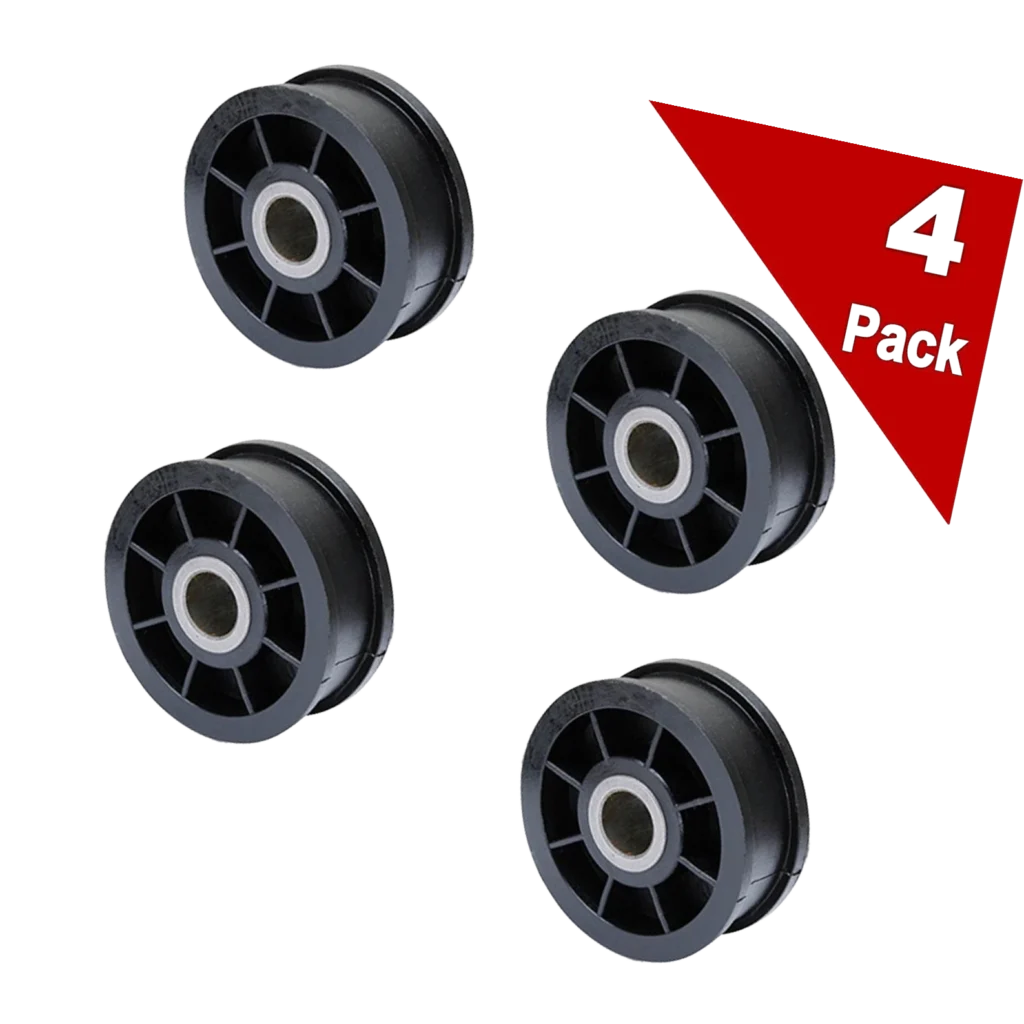
Nine times out of ten, you're dealing with an idler pulley issue. This small wheel (part Y54414) keeps tension on the belt that spins your drum. When its bearing seizes or the wheel itself cracks, everything falls apart fast.
Let's diagnose what's actually broken in your dryer.
Quick Symptom Check
Before you pull anything apart, confirm what you're hearing and seeing:
- High-pitched squeal or grinding noise that starts right when the dryer motor kicks on
- Drum turns freely by hand but won't spin when you start the dryer
- Motor runs but drum doesn't move — you hear the blower but no tumbling
- Rhythmic thumping or clicking that gets faster as the motor speeds up
- Belt sitting loose inside the dryer cabinet when you peek inside
If you've got that grinding noise, we're likely looking at a worn idler pulley. If the drum won't spin at all, the pulley bearing may have completely seized or the spring arm broke.
Cause #1: Seized Idler Pulley Bearing (Most Likely — 65% of Cases)
The idler pulley wheel spins on a bearing that eventually wears out. When it does, the wheel stops rotating freely. Instead of spinning smoothly, it drags against the belt — that's your grinding noise.
How to diagnose: Unplug the dryer, remove the front or top panel (depends on your model), and locate the idler pulley. It's a small wheel on a spring-loaded arm near the motor. Try spinning the wheel with your finger. It should rotate effortlessly. If it's stiff, gritty, or won't turn at all, the bearing is shot.
The fix: Replace the entire idler pulley assembly (Y54414). Don't try to just lubricate it — the bearing is sealed and once it's gone, it's gone. This part fits Whirlpool models like WED5000DW0 and MGD5000DW0, Maytag models like MEDC400VW0 and SDE3606AYW, plus Amana, Speed Queen, and Kenmore models including 110.96273100.
Cost: $18.99 for the pulley, about 45 minutes of your time.
Cause #2: Cracked or Worn Pulley Wheel (20% of Cases)
Even if the bearing still spins, the plastic wheel itself can crack or develop a groove from years of belt friction. When the wheel edge gets worn down, the belt slips or tracks unevenly, causing noise and inconsistent drum rotation.
How to diagnose: Look closely at the outer rim of the pulley wheel where the belt makes contact. You're checking for visible cracks, a deep groove worn into the plastic, or chunks missing from the edge. Run your finger along the belt contact surface — it should be smooth and round, not grooved or sharp.
The fix: Same as above — replace the Y54414 pulley assembly. The wheel and bearing come as one unit, so you're swapping the whole thing anyway.
Cause #3: Broken or Weakened Idler Spring (10% of Cases)
The idler pulley sits on a spring-loaded arm that keeps constant tension on the belt. If that spring breaks or stretches out, the pulley can't hold the belt tight. Result: belt slips off or doesn't have enough grip to turn the drum.
How to diagnose: With the panel off, push the idler pulley toward the motor to release belt tension, then let it go. It should snap back firmly. If it barely moves or the spring looks stretched out (compare it to a new one if you're not sure), it's weak. Check for a broken spring mount or missing spring entirely — sometimes they pop off.
The fix: The Y54414 assembly includes the spring bracket. When you replace the pulley, you're replacing the spring mechanism too. Just make sure you route the new spring correctly — there's usually a hook point on the dryer frame.
Cause #4: Worn Drive Belt Creating False Pulley Failure (5% of Cases)
Sometimes the belt itself is so glazed, stretched, or frayed that it slips across the pulley and drum, making noise that sounds like a bad pulley. The pulley might actually be fine.
How to diagnose: Remove the belt and inspect it. Look for glazing (shiny, hardened surface), cracks, fraying edges, or excessive stretching. A good belt has a slightly grippy rubber texture. Measure it if you can — most dryer belts are 90-93 inches long when new. If yours is 95+ inches, it's stretched out.
The fix: Replace the belt. But honestly? If you're already in there replacing the belt, throw in the new idler pulley too. It's $19 and prevents you from going back in six months later when the pulley finally gives up.
When to Call a Pro
This is a straightforward DIY repair if you're comfortable using a screwdriver and have an hour to spare. You don't need to move the dryer or disconnect gas lines for most models — just tilt it back or remove the front panel.
Call a tech if:
- You're dealing with a stacked washer/dryer unit where access is complicated
- The motor itself won't run (not just the drum — I mean the motor is completely dead)
- You replaced the pulley and belt but still have the same symptoms — could be a motor pulley or tension issue
Otherwise, save the $150-$200 service call and do it yourself.
Frequently Asked Questions
How long does an idler pulley usually last in a Whirlpool dryer?
Typically 8-12 years depending on how often you run the dryer. High-use households (multiple loads daily) might see failure closer to 6-7 years. The bearing wears out from constant friction and heat cycling. Once you start hearing noise, you've got weeks to maybe a couple months before it completely seizes.
Can I run my dryer if the idler pulley is making noise?
You can, but don't. A noisy pulley is on its way to seizing completely. When it does, the belt stops moving, the motor keeps trying to run, and you risk burning out the motor or thermal fuse. Plus, the noise will drive you insane. Just replace it now while it's a $19 part instead of a $200+ motor replacement later.
Do I need to replace the belt when I replace the idler pulley?
Not necessarily, but inspect it carefully while you're in there. If the belt looks good — no cracks, fraying, or glazing — you can reuse it. But if it's been slipping on a bad pulley for weeks, it's probably glazed smooth and won't grip properly anymore. For an extra $15-20, replacing both at the same time gives you peace of mind and avoids another teardown soon.
Diagnosed the problem?
Y54414 · In Stock · Fast shipping