
Maytag Washer Won't Fill with Cold Water — 4 Causes & How to Fix
You started a load of whites, hit start, and walked away. Ten minutes later you come back to find the drum bone dry — no water at all, or maybe just a trickle of hot water but nothing cold. The cycle's stuck in endless waiting mode, and your laundry's going nowhere.
This cold water inlet issue hits Maytag front-loaders hard, especially the MHW5630 and MHW6630 series. The good news? It's usually the inlet valve, and you can diagnose it in about fifteen minutes.
Quick Symptom Check
Before you grab tools, confirm what's actually happening:
- No cold water enters the drum — hot water works fine, cold doesn't come at all
- Weak cold water flow — barely a trickle when it should be a strong stream
- Water leaking from inlet connections — puddles behind the washer near the hoses
- Dispenser drawer issues — detergent or fabric softener not dispensing properly because water pressure's off
- Error codes — some models show F8E1 or similar water inlet errors
If you're seeing any combination of these, you're dealing with either the inlet valve itself, the supply system feeding it, or the machine's control board that tells the valve when to open.
Cause #1: Failed Cold Water Inlet Valve Solenoid (65% of Cases)
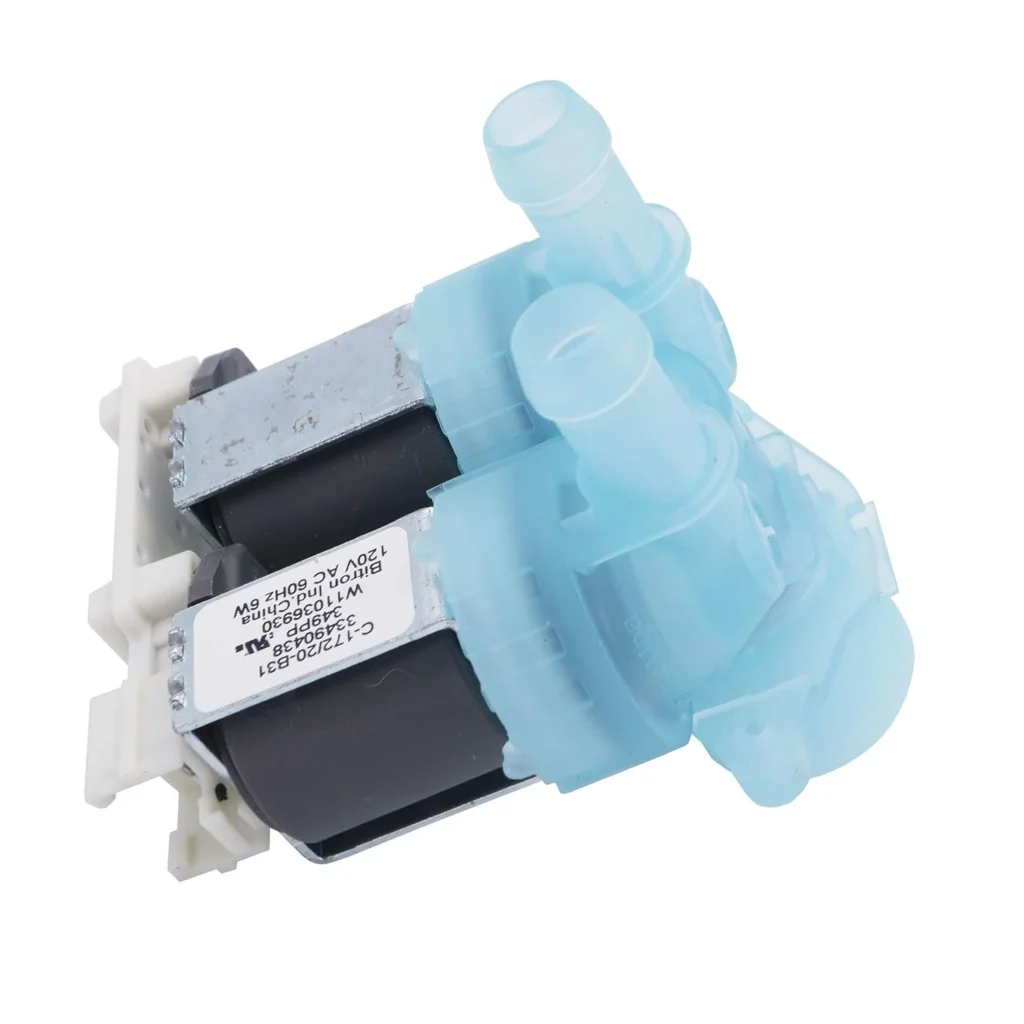
The W11316256 inlet valve has two solenoids — one for hot, one for cold. Each solenoid is essentially an electromagnet that opens a gate when the control board sends power. When the cold side fails, that gate stays shut.
How to diagnose:
- Unplug the washer and turn off both water supply valves
- Pull the machine away from the wall so you can access the back panel
- Locate the inlet valve — it's where the two hoses connect at the top back
- Disconnect the wire harness from the valve
- Use a multimeter set to ohms — test across the cold water solenoid terminals
- You should read 500-1500 ohms; anything outside that range means it's dead
Why it fails: Mineral deposits from hard water gradually clog the valve screens and coat the solenoid coil. After a few years, the solenoid can't generate enough magnetic force to open the valve gate, or the coil burns out completely trying.
The fix: Replace the entire inlet valve assembly with W11316256. This isn't a repair job — once a solenoid fails, you swap the whole unit. Takes about 30 minutes if you've done it before, maybe an hour your first time.
Cause #2: Clogged Inlet Screens (20% of Cases)
Inside each inlet port where your hoses connect, there's a tiny mesh screen that catches sediment. These screens are maybe the size of a dime, and they clog with calcium, rust particles, and random gunk from your water supply.
How to diagnose:
- Turn off water supply and unplug the machine
- Disconnect both inlet hoses from the back of the washer
- Shine a flashlight into each inlet port — you'll see the screens
- Use needle-nose pliers to gently pull each screen out
- Check for visible debris, discoloration, or crusty buildup
If the cold water screen looks packed with sediment while the hot side's relatively clean, you've found it. Sometimes just one screen clogs worse because of how your home's plumbing routes cold vs. hot water.
The fix: You can try cleaning the screens with white vinegar and an old toothbrush, but honestly, if they're bad enough to stop water flow, you're better off replacing the valve. New screens come with the W11316256 replacement valve, and you'll have fresh solenoids too.
Cause #3: Supply Hose or Shutoff Valve Problem (10% of Cases)
Before you blame the washer, check what's feeding it. The cold water shutoff valve might be partially closed, the supply hose could be kinked, or the hose washer inside the connection might be blocking flow.
How to diagnose:
- Check that the cold water shutoff valve is turned fully counterclockwise (fully open)
- Disconnect the cold water hose from the washer inlet
- Put the hose end into a bucket and turn the shutoff valve on briefly
- You should get strong flow — if it's weak or nonexistent, the problem's upstream
Look for kinked hoses, especially if you recently moved the washer. Sometimes pushing a front-loader back against the wall crushes the hoses. Also check inside the hose connections for deteriorated rubber washers that might've collapsed and blocked the opening.
The fix: Replace any damaged hoses, ensure shutoff valves are fully open, and replace the rubber washers in the hose connections. If your shutoff valve is old and crusty, consider replacing it — they're cheap and a failed shutoff valve can flood your laundry room.
Cause #4: Control Board Not Signaling the Valve (5% of Cases)
Least common but most expensive — the main control board might've stopped sending the 120V signal that tells the cold water solenoid to open. This usually comes with other weird symptoms, not just cold water problems.
How to diagnose:
- With the washer plugged in and hoses connected (but supply valves off), start a cold wash cycle
- Use a multimeter to check for voltage at the cold water solenoid terminals during fill
- You should read 120V AC when the machine's trying to fill with cold water
- No voltage? The control board's the culprit
Be extremely careful with this test — you're working with live voltage. If you're not comfortable, skip this and call a pro.
The fix: Control board replacement runs $200-400 in parts alone, plus labor if you hire it out. At that price point, consider the washer's age. If it's over 8 years old with a failed board, you might be better putting that money toward a new machine.
When to Call a Pro
The inlet valve swap is genuinely DIY-friendly — you need basic hand tools and maybe 45 minutes. But call in a tech if:
- You tested voltage at the valve and found the control board isn't sending power
- You replaced the inlet valve but still have no cold water (points to wiring harness issues)
- There's active leaking you can't trace to a simple connection
- Your washer's still under warranty (don't void it for a $59 part)
Service call for this runs $150-250 depending on your area. The valve itself is $58.99, so you're mainly paying for their time and expertise if the diagnosis gets complicated.
Frequently Asked Questions
Can I just use hot water washes if my cold water inlet fails?
Short term, yes, but it's not a solution. Hot water washes cost way more (you're heating all that water), they'll shrink and fade your clothes, and many detergents don't work right in hot water. Plus, the machine might error out on certain cycles that specifically require cold water. Fix the inlet valve rather than working around it.
Will the W11316256 valve fit my Maytag MHW5630HC washer?
Yes — that's one of the primary models this valve was designed for. It also fits the MHW6630 series and various Whirlpool and Amana front-loaders. The compatible models list includes MHW5630HC0 through HC3, MHW5630HW0 through HW3, and dozens more. Check your model number against the full compatibility list to be certain.
How long do these inlet valves typically last?
Average lifespan is 5-7 years with normal use and decent water quality. Hard water areas see failures closer to 4-5 years because mineral buildup accelerates solenoid wear. If you've got really hard water, installing an inline filter on your washer's cold supply line can extend valve life significantly — you'll spend $30 on a filter instead of $60 on valves every few years.
Diagnosed the problem?
W11316256 · In Stock · Fast shipping