
Whirlpool Washer Won't Drain — 6 Causes & How to Fix W10403802
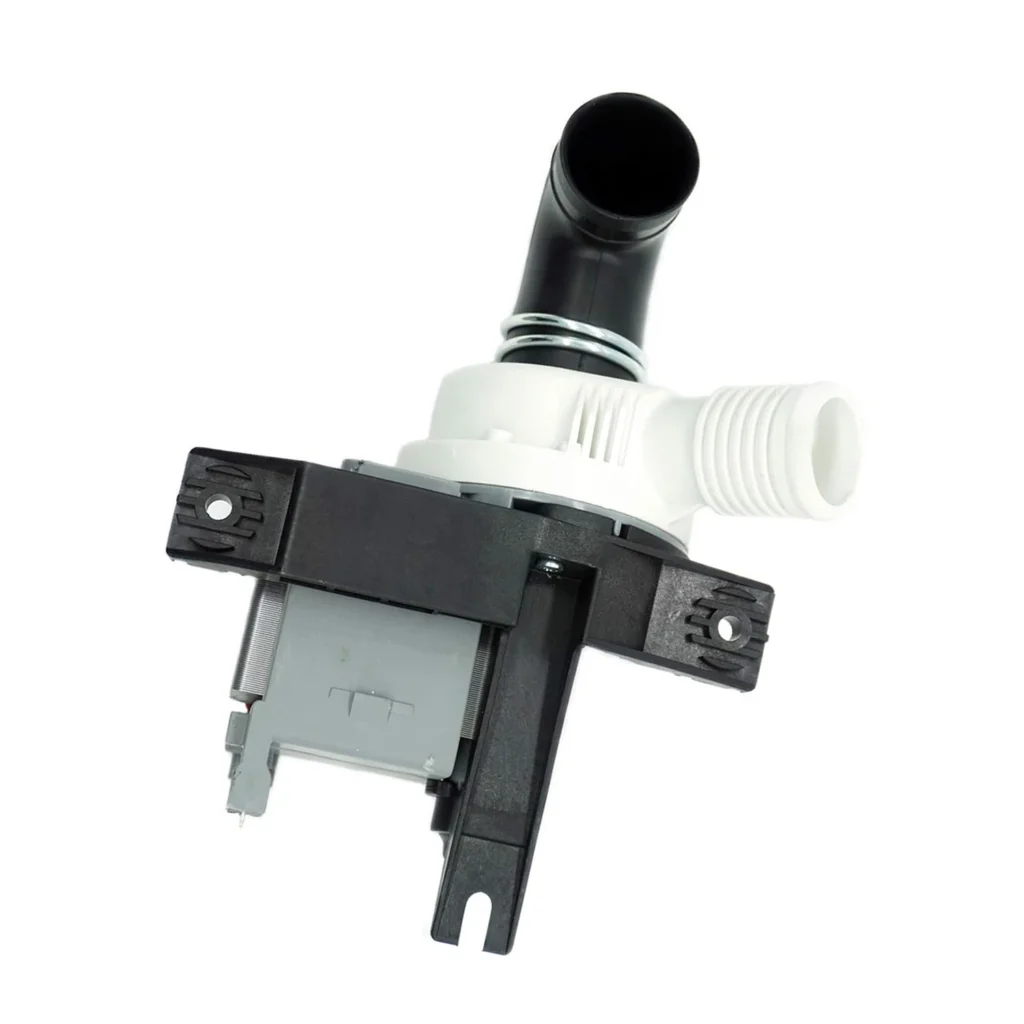
You opened your Whirlpool or Maytag washer expecting clean, damp clothes, but instead found a tub full of standing water and soaking wet laundry. Sound familiar? If your WTW8000BW0 or MVWB850YG1 is refusing to drain, you're dealing with one of the most common washer failures — and the drain pump (W10403802) is usually the prime suspect.
This isn't just annoying. Standing water means you can't finish laundry, and wet clothes sitting in the drum start smelling musty within hours. Let's diagnose what's actually wrong before you start ordering parts.
Quick Symptom Check
Before we dive into causes, confirm you're seeing these symptoms:
- Standing water in the tub after the cycle completes
- Drain cycle starts but water doesn't move — pump hums but nothing happens
- Error codes like F9 E1 or F8 E1 (drain timeout errors)
- Clothes are soaking wet — much wetter than normal damp
- Gurgling or grinding sounds during what should be the drain cycle
- Washer stops mid-cycle and displays drain-related codes
If you're nodding along to three or more of these, keep reading. We'll go through the six most likely causes in order of probability.
Cause #1: Failed Drain Pump Motor (60% of Cases)
The W10403802 drain pump has a motor that eventually wears out. These pumps typically last 5-8 years, but they work hard — draining 15-20 gallons per load, multiple times a day.
How to diagnose:
- Start a drain cycle and listen closely at the bottom front of the washer
- If you hear absolutely nothing — no hum, no vibration — the pump motor is likely dead
- If you hear humming but no water movement, the impeller inside is probably jammed or broken
- Check for burning smells near the pump area (sign of motor burnout)
Probability: 60% — This is by far the most common cause on models like the 7MWTW8800AW0, MVWB950YW1, and MVW8850YG1. Pumps simply wear out from constant use and exposure to detergent buildup.
DIY difficulty: Moderate. You'll need to tip the washer back or remove the front panel to access the pump. The pump itself just twists off — no soldering or complex wiring.
Part needed: W10403802 drain pump assembly ($114.99). Make sure you're getting the genuine part — knockoffs fail within months.
Cause #2: Clogged Pump or Drain Hose (25% of Cases)
Even if the pump motor works perfectly, it can't push water through a blockage. Coins, hair ties, small socks, and lint love to jam themselves into the pump chamber or drain hose.
How to diagnose:
- Unplug the washer and locate the drain pump (bottom front, behind access panel)
- Place towels on the floor — you'll release water when you open the pump
- Twist the pump filter cap counterclockwise and remove it
- Check for debris: bobby pins, coins, buttons, fabric chunks
- While you're there, shine a flashlight into the pump housing — look for broken impeller blades
- Follow the drain hose from pump to standpipe — squeeze along its length feeling for clogs
Probability: 25% — Especially common in households with kids or if you don't empty pockets before washing.
DIY difficulty: Easy. This is a 15-minute check that costs nothing and solves the problem a quarter of the time.
Cause #3: Broken Pump Impeller (8% of Cases)
The impeller is the little plastic fan blade inside the pump that actually moves water. It can break, crack, or wear down to nubs if the pump runs against a blockage too long.
How to diagnose:
- Remove the pump (see installation steps below)
- Look through the inlet openings with a flashlight
- The impeller should have 4-6 distinct blades — if they're chipped, melted, or missing, that's your problem
- Try spinning the impeller with your finger — it should turn freely with slight resistance
- If it won't spin at all or spins with zero resistance (broken shaft), the pump assembly needs replacement
Probability: 8% — Usually happens after the pump ran against a blockage for multiple cycles.
DIY difficulty: Moderate. Once you've removed the pump to inspect it, you might as well replace it rather than trying to source just the impeller.
Cause #4: Faulty Drain Pump Wiring or Connector (4% of Cases)
The pump gets power through a wire harness connector. If this connector corrodes, comes loose, or the wires break, the pump won't run even though it's mechanically fine.
How to diagnose:
- Unplug the washer and access the pump
- Inspect the wire connector on the pump — look for corrosion (white/green crusty stuff)
- Check the wires leading to the connector for fraying or breaks
- Try wiggling the connector while someone starts a drain cycle (washer plugged in, door closed to trigger) — if the pump starts working intermittently, bad connection
- Use a multimeter to check for 120V AC at the pump connector during drain cycle
Probability: 4% — Less common, but increasing in washers that have leaked water onto electrical components.
DIY difficulty: Moderate to hard. If it's just a loose connector, easy fix. If wires are broken inside the harness, you're looking at splicing work or replacing the entire wire harness.
Cause #5: Control Board Not Sending Drain Signal (2% of Cases)
The main control board tells the pump when to run. If the board's relay fails or the programming glitches, the pump never gets the command to start.
How to diagnose:
- This is a process-of-elimination diagnosis — if the pump works when you apply direct power to it, but won't run during a cycle, suspect the board
- Try running a diagnostic mode (varies by model — usually involves holding specific button combinations at startup)
- Listen for relay clicking on the control board when the drain cycle should start
- Check for error codes that specifically point to control board issues
Probability: 2% — Rare, and usually shows other symptoms too (display errors, other cycle problems).
DIY difficulty: Hard. Control boards run $200-400 and require careful installation. Consider professional diagnosis before replacing.
Cause #6: Kinked or Improperly Installed Drain Hose (1% of Cases)
Sometimes the simplest explanation is the right one. If the drain hose is kinked, crushed behind the washer, or inserted too far into the standpipe, water can't flow even with a working pump.
How to diagnose:
- Pull the washer away from the wall
- Trace the entire drain hose from washer to standpipe
- Look for sharp bends, kinks, or places where the hose is compressed
- Check that the hose isn't inserted more than 4-6 inches into the standpipe (creates a siphon lock)
- Verify the standpipe itself isn't clogged — pour a bucket of water down it and make sure it drains quickly
Probability: 1% — Usually only happens right after installation or if someone moved the washer recently.
DIY difficulty: Easy. Straighten the hose, adjust the standpipe depth, and you're done.
Step-by-Step: Replacing the W10403802 Drain Pump
If you've diagnosed a bad pump, here's how to replace it:
Tools needed:
- 1/4" nut driver or socket set
- Flat-head screwdriver
- Towels (you'll release water)
- Work gloves
- Bucket or shallow pan
Time required: 30-45 minutes for most DIYers
Steps:
- Unplug the washer — non-negotiable. You're working near electrical components and water.
- Turn off water supply valves at the wall (usually not necessary for pump work, but safer)
- Drain remaining water: Most models have a drain pump filter access panel at the front bottom. Open it, place towels down, and twist the filter cap slowly to release water into your bucket. This prevents a flood when you remove the pump.
- Access the pump: Depending on your model (WTW8000BW0, 7MMVWB950AG0, etc.), you'll either:
- Tip the washer backward against the wall (most top-loaders) — pump is accessible from bottom
- Remove the front lower panel (some models) — held by clips or screws
- Disconnect the hoses: The pump has two or three hose connections. Use pliers to squeeze the hose clamps and slide them back. Pull hoses off — more water will drain, so keep that bucket handy.
- Disconnect the wire harness: Press the locking tab and pull the connector straight off the pump.
- Remove the old pump: The W10403802 usually mounts with a twist-lock mechanism. Rotate the entire pump assembly counterclockwise about 1/8 turn and pull it out. Some models use mounting screws instead — remove them.
- Compare old and new: Before installing, verify your new W10403802 matches the old one exactly. Check the outlet orientations and mounting style.
- Install the new pump: Reverse the removal process. Insert the pump, twist clockwise to lock (or secure with screws). Reconnect the wire harness until it clicks. Reattach all hoses and secure with clamps.
- Test before buttoning up: Plug the washer in and run a drain or spin cycle. Watch the pump area for leaks. Listen for proper operation (smooth humming, water flowing).
- Reassemble: If everything works, return the washer to its normal position or replace the access panel.
Common mistake: Not fully seating the hose clamps. If they're loose, you'll have slow leaks that damage your floor over time. Make sure clamps are past the hose ridges.
When to Call a Pro
Look, I'm all for DIY repairs — they save money and you learn something. But call a professional if:
- You've replaced the pump and the washer still won't drain (points to control board or deeper electrical issues)
- You're uncomfortable tipping the washer or working with the electrical connector
- Your washer is still under warranty — DIY work usually voids it
- You find water damage or rust around the pump area (may indicate bigger problems like a leaking tub seal)
- The diagnostic process reveals multiple failing components
A service call runs $150-250 for diagnosis plus parts. If the technician confirms you need a $115 pump plus an hour of labor, you're looking at $250-300 total. Weigh that against the DIY cost of just the pump and your time.
Preventing Future Drain Pump Failures
Once you've fixed the immediate problem, extend your new pump's life:
- Empty pockets completely — coins kill pumps faster than anything else
- Use mesh laundry bags for items with small parts (baby socks, delicates with hooks)
- Run a cleaning cycle monthly with washer cleaner or white vinegar — removes detergent buildup
- Don't overload — excess weight and water stress the pump motor
- Check the pump filter quarterly — that 5-minute inspection catches clogs before they damage the impeller
Frequently Asked Questions
How long does a Whirlpool washer drain pump typically last?
Most W10403802 drain pumps last 5-8 years with normal use (8-10 loads per week). Heavy-use households might see failure around the 4-year mark. The pump motor's brushes wear down gradually, and the plastic impeller degrades from constant water flow and detergent exposure. If your washer is 6+ years old and showing drain issues, pump failure is very likely.
Can I use a generic drain pump instead of the W10403802?
Technically some aftermarket pumps claim compatibility, but I don't recommend it. The W10403802 is engineered specifically for the flow rate and pressure requirements of models like the MVWB950YG1 and 7MWTW8800AW0. Generic pumps often use weaker motors or cheaper plastic impellers that fail within 6-12 months. You'll spend $60 on a knockoff, it'll die, and you'll buy the genuine part anyway. Save yourself the hassle — get the real W10403802 or the equivalent WPW10403802 from the start.
Why does my washer drain pump make a loud grinding noise?
Grinding means something's obstructing the impeller — usually a small object like a coin, screw, or broken piece of plastic stuck in the pump chamber. Stop using the washer immediately. Running the pump against an obstruction will overheat the motor and crack the impeller blades, turning a $5 foreign-object problem into a $115 pump replacement. Unplug the washer, access the pump filter (front bottom access panel), and remove any debris. If grinding continues after clearing blockages, the impeller blades are already damaged and you need a new pump assembly.
Diagnosed the problem?
W10403802 · In Stock · Fast shipping