
LG Dishwasher Won't Drain — 5 Causes & How to Fix It
You open your LG dishwasher after the cycle ends, and there's standing water at the bottom. Maybe it's an inch deep, maybe it's covering the heating element. Either way, your dishes aren't clean, and that stagnant water isn't going anywhere.
This is one of the most common dishwasher failures, and the good news? About 70% of drain problems come down to just two parts: the drain pump assembly or a clogged drain path. Let's walk through the actual causes, starting with the most likely culprit.
Quick Symptom Check
Before you start diagnosing, confirm what you're seeing:
- Standing water after cycle completes — anywhere from 1/4 inch to several inches
- No drain pump noise during drain cycle — should hear a distinct humming or buzzing
- Error code OE displayed on control panel (stands for "drain error")
- Gurgling sounds but no actual drainage
- Slow drainage — takes 10+ minutes or never fully empties
If you're seeing two or more of these, you've got a legitimate drain problem.
Cause #1: Failed Drain Pump Assembly (Most Likely — 40% of Cases)
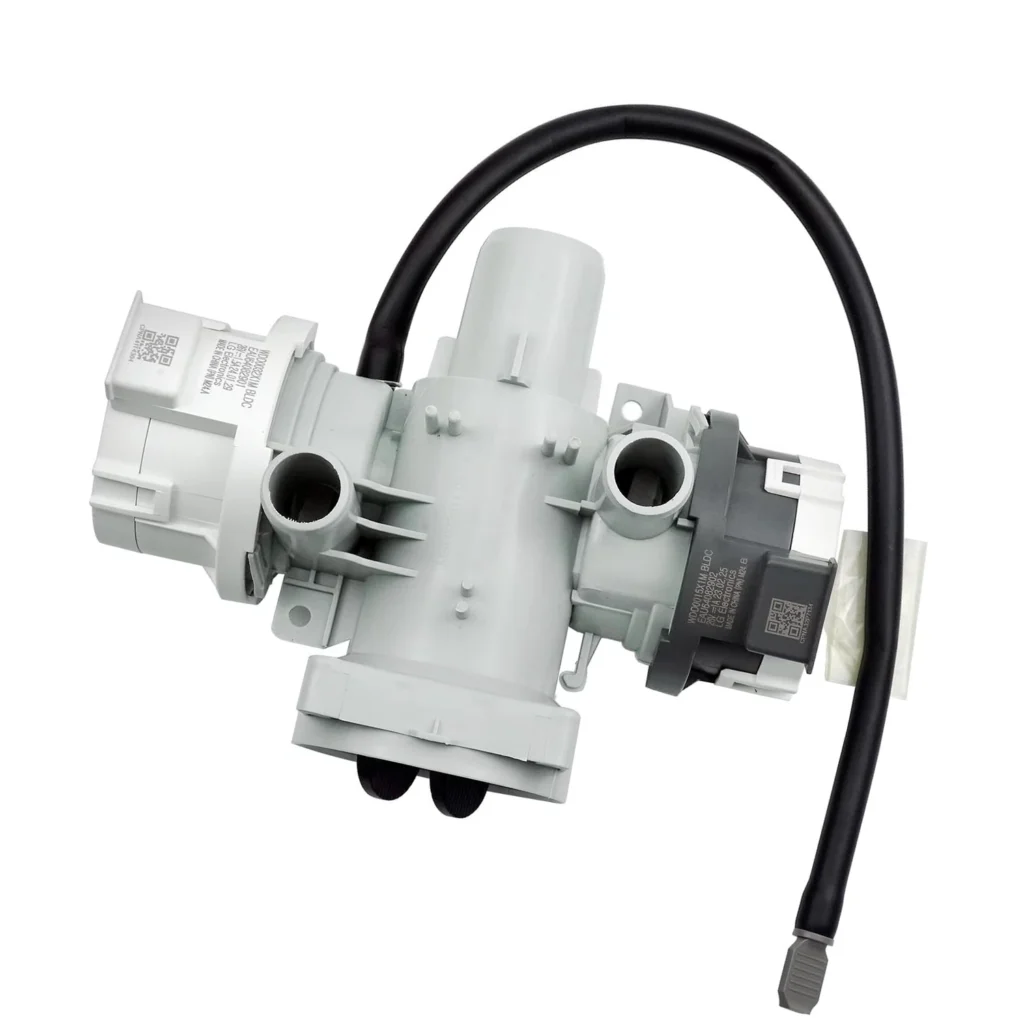
The drain pump on LG dishwashers like the W3S1CVK2WVS, F4V9RCP2W, and SWWE50N3 is a hardworking component. It runs every single cycle, pushing water through a narrow discharge tube against gravity. After 5–7 years, the motor windings fail or the impeller cracks.
How to diagnose:
- Start a drain cycle and listen carefully at the bottom left of the dishwasher
- You should hear a distinct humming within 5–10 seconds
- If you hear nothing, the pump motor is likely dead
- If you hear humming but no water movement, the impeller is jammed or broken
- Remove the lower spray arm and filter assembly — check if the pump inlet is blocked
Probability: High if your dishwasher is 4+ years old and you hear no pump activation sound.
The fix: Replace the drain pump assembly (part AHA75693423, replaces LG factory numbers EAU64082902, EAU64082901). This is the complete assembly — motor, impeller, and housing. You'll need to access the bottom of the dishwasher, disconnect two wire harnesses, twist off the old pump, and install the new one. Most people can do this in 30–45 minutes.
Cost: Pump assembly runs $63.99, professional install adds $120–$180 in labor.
Cause #2: Clogged Drain Filter or Chopper Blade (30% of Cases)
LG dishwashers have a multi-stage filtration system at the bottom of the tub. Food debris, broken glass, twist ties, and other junk accumulates here. If you've never cleaned this filter — and be honest, most people haven't — it's probably restricting water flow.
How to diagnose:
- Open the dishwasher and remove the lower spray arm (usually just lifts off)
- You'll see a cylindrical filter assembly — twist counterclockwise and lift out
- Rinse under hot water and inspect for debris buildup
- Look underneath where the filter sat — that's the chopper blade area
- Use a flashlight to check for visible obstructions
Probability: Very high if you've never removed and cleaned this filter.
The fix: Clean thoroughly with hot water and a brush. If the chopper blade itself is broken (you'd see cracked plastic fins), you'll need to replace the entire pump assembly since it's integrated. This is actually where a pump failure often starts — something jams the chopper, which burns out the motor.
Cause #3: Kinked or Clogged Drain Hose (15% of Cases)
The drain hose runs from the pump to either your garbage disposal or sink drain. If someone shoved the dishwasher back too hard during installation, the hose can kink. Or food particles build up inside the hose over years.
How to diagnose:
- Pull the dishwasher forward slightly (turn off power first)
- Trace the drain hose from the pump to the disposal connection
- Look for obvious kinks or loops that dip below the pump level
- Disconnect the hose at the disposal end and blow through it — should have clear airflow
Probability: Moderate if your drainage problems started after the dishwasher was moved or reinstalled.
The fix: Straighten kinked sections, or replace the drain hose entirely if it's clogged internally. The hose should have a high loop near the countertop to prevent backflow — this is code in most areas.
Cause #4: Garbage Disposal Knockout Plug Not Removed (10% of Cases)
This is a rookie installation mistake but happens more than you'd think. If your dishwasher was installed at the same time as a new garbage disposal, there's a knockout plug inside the disposal inlet that must be removed. If it wasn't, water can't drain.
How to diagnose:
- This only applies if you have a garbage disposal
- Problem would've existed from day one of installation
- Disconnect drain hose from disposal
- Shine a light into the disposal inlet — if you see a solid plastic disc, that's your problem
Probability: Only relevant for new installations, but 100% certain if the plug is still there.
The fix: Turn off disposal power at the breaker. Use a screwdriver and hammer to punch out the knockout plug from inside the disposal. Fish out the plastic disc so it doesn't jam the disposal blades. Reconnect the drain hose.
Cause #5: Electronic Control Board Failure (5% of Cases)
Least likely, but possible. The main control board sends voltage to the drain pump motor. If that relay circuit fails, the pump won't receive power even if it's mechanically perfect.
How to diagnose:
- This is tough without a multimeter
- If the pump is brand new or tests good with direct voltage, suspect the board
- Other symptoms might include random error codes or cycle interruptions
- Check for 120V at the pump connector during drain cycle
Probability: Low unless you've already replaced the pump with no improvement.
The fix: Replace the main control board. This is expensive ($200–$350 for the part) and honestly, at that point, you might be looking at replacement versus repair math.
When to Call a Pro
Be straight with yourself: if you're not comfortable pulling the dishwasher out, working with water connections, or testing electrical components with a multimeter, call someone. Water damage from a reconnection mistake will cost way more than a $150 service call.
That said, replacing the drain pump assembly is genuinely straightforward — it's designed to be serviceable. If you can use a screwdriver and follow a diagram, you can do this repair.
Definitely call a pro if you're seeing error codes beyond OE, or if the dishwasher is less than 2 years old and still under warranty.
Frequently Asked Questions
How do I know if my LG dishwasher drain pump is bad?
Start a drain cycle and listen for pump activation — you should hear a distinct humming or buzzing sound within 10 seconds. If there's complete silence, the pump motor is dead. If you hear humming but no water movement, the impeller is jammed or broken. Standing water combined with no pump noise is a near-certain pump failure.
Can I run my dishwasher if the drain pump isn't working?
No, don't run additional cycles. The standing water will get pushed around but won't drain, and you'll just be recirculating dirty water over your dishes. Plus, the dishwasher will likely throw an OE error code and pause mid-cycle anyway. Fix the drainage problem first.
What's the part number I need for LG dishwasher models like W3S1CVK2WVS or SWWE50N3?
You'll need drain pump assembly AHA75693423, which replaces LG original part numbers EAU64082902 and EAU64082901. This is compatible with dozens of LG models including the W3S1CVK series, F4V9RCP series, and SWWE50/SWWG50 series. It's a direct-fit replacement with the same mounting pattern and electrical connections.
Diagnosed the problem?
AHA75693423 · In Stock · Fast shipping