
LG Dryer Tripping Breaker or Overheating — 4 Causes & How to Fix
You're halfway through drying a load of towels when the breaker trips. Again. You reset it, restart the dryer, and twenty minutes later — click. Everything goes dark. Or maybe your dryer isn't tripping the breaker, but clothes are coming out scorching hot, and you're starting to worry about fire risk.
Both symptoms point to the same culprit nine times out of ten: a failing heating element. When the element in your LG dryer develops a short or breaks down, it can draw excessive current that trips your breaker, or it can overheat and create dangerously high temperatures inside the drum.
Quick Symptom Check
Before you start diagnosing, confirm what's happening with your dryer:
- Breaker trips during the drying cycle — usually within 5-20 minutes of starting
- Breaker trips immediately when you start the dryer — indicates a direct short
- Clothes come out extremely hot — sometimes too hot to touch comfortably
- Burning smell during operation, even if it completes the cycle
- Scorch marks on clothes or drum feels hotter than normal to the touch
If you're experiencing any combination of these, you're likely dealing with heating element failure. Let's break down the causes from most to least common.
Cause #1: Shorted Heating Element (85% Probability)
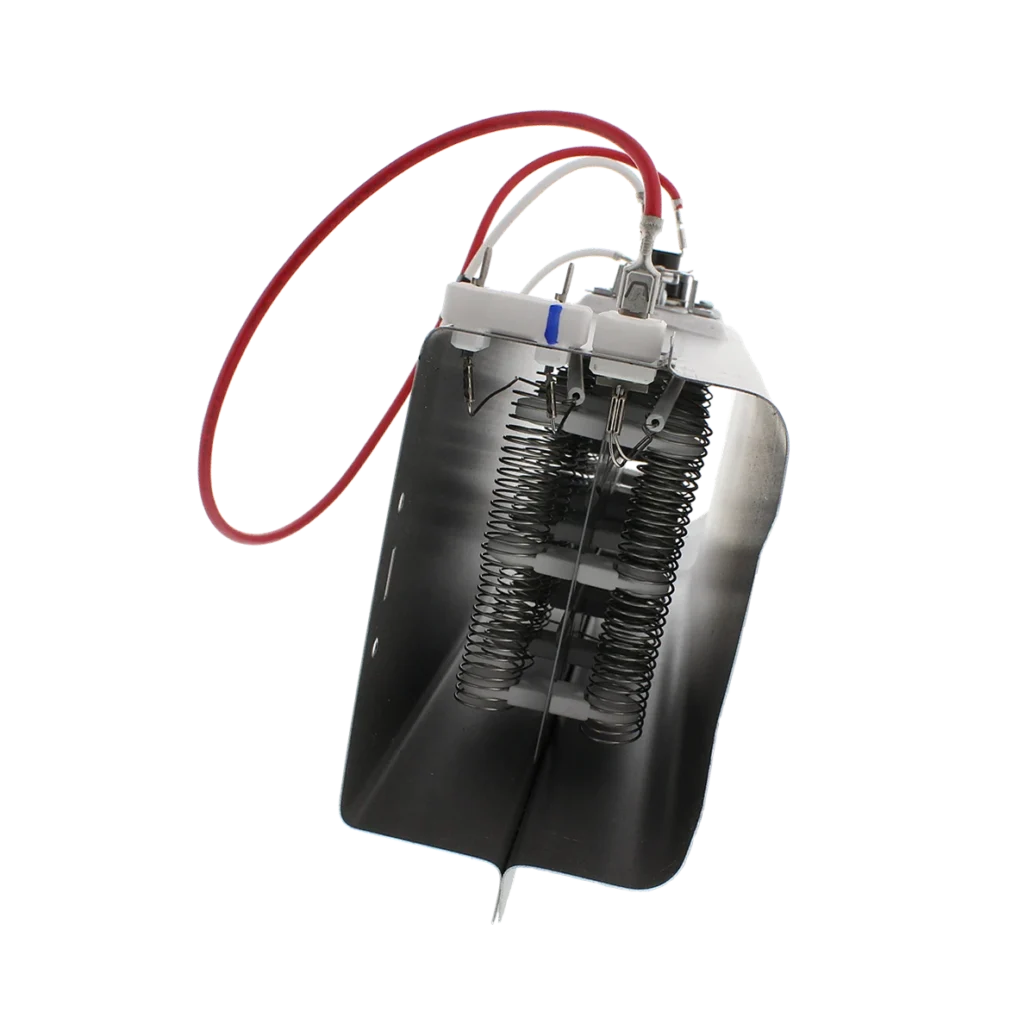
The heating element in LG dryers like the DLE2301W, DLEX3875W, and DLE5955W is a coiled wire assembly that heats air as it passes through. Over time — typically 8-12 years of use — the element wire deteriorates. It can develop breaks, sag and touch the housing, or simply burn through.
When the element shorts, it creates a direct path for electricity that bypasses the normal resistance. Your breaker detects this surge and trips to protect your home's electrical system. One user noted they "replaced obviously burnt element with element assembly" — that visible burn damage is the smoking gun.
How to diagnose:
- Unplug the dryer and pull it away from the wall
- Remove the lower front panel (two screws at bottom corners)
- Locate the heating element housing — cylindrical metal canister on the right side
- Disconnect the two wire terminals and remove the housing (usually two mounting screws)
- Visually inspect the coil through the openings — look for breaks, dark burn spots, or sagging wire touching metal
- Use a multimeter set to continuity mode: test from each terminal to the metal housing — if you get continuity, the element is shorted and must be replaced
The fix: Replace with part 5301EL1001J. The element assembly includes the housing, coil, and thermal fuse. This is a straightforward swap — pliers and screwdrivers are the only tools you need. Expect 15-30 minutes for the repair.
Cause #2: Failed Cycling Thermostat (10% Probability)
The cycling thermostat regulates temperature by switching the heating element on and off. When this component fails in the closed position, the element stays on continuously, creating excessive heat. Your dryer gets way too hot, and in extreme cases, the constant draw can trip the breaker.
This is less common than element failure, but it happens — especially in dryers that have run thousands of cycles. You'll notice the overheating symptom before you see breaker trips with this issue.
How to diagnose:
- Access the heating element housing (same steps as above)
- The cycling thermostat is attached to the housing — small disc about the size of a quarter
- Test with multimeter: at room temperature, it should show continuity; when heated above its rated temperature, continuity should break
- If it shows no continuity at room temp, or constant continuity when heated, it's failed
The fix: Replace the cycling thermostat. When you're replacing the heating element anyway, consider replacing the thermostat at the same time — they're often sold together and it prevents a second repair trip later.
Cause #3: Restricted Airflow Causing Element Stress (4% Probability)
Sometimes the heating element isn't actually defective — it's being forced to work too hard because of restricted airflow. When lint builds up in the exhaust duct, blower wheel, or lint screen housing, the element stays on longer trying to heat poorly circulating air. This extended runtime stresses the element and can cause it to fail prematurely or overheat.
How to diagnose:
- Check exhaust vent outside — put your hand near it while dryer runs, airflow should be strong
- Inspect the duct for kinks, crushing, or lint buildup
- Remove the lint screen and shine a flashlight into the housing — you'd be surprised how much lint packs in there
- Check blower wheel for lint wrapping around it (access through bottom front panel)
The fix: Deep clean the entire exhaust system. Disconnect the duct from the dryer and vacuum it out thoroughly. Use a duct cleaning brush if you have a long run. Even if this isn't your primary issue, you should do this maintenance anyway — it's a fire hazard and efficiency killer.
Cause #4: Defective High-Limit Thermostat (1% Probability)
The high-limit thermostat is a safety device that cuts power to the element if temperature exceeds safe levels. When it fails, it can either prevent the dryer from heating at all, or in rare cases, fail to cut off power when needed, allowing dangerous overheating.
This almost never causes breaker trips directly, but it can contribute to the "too hot" symptom. If you've replaced the element and cycling thermostat and still have overheating, test the high-limit.
How to diagnose: Use a multimeter to test for continuity. It should show continuity at room temperature. If it's open (no continuity), it's blown and needs replacement.
When to Call a Pro
Here's the honest truth: replacing a heating element in an LG dryer is genuinely easy. If you can use a screwdriver and aren't intimidated by unplugging a few wire connectors, you can do this repair. The element housing is accessible from the front, the part just slides out, and there's no complex diagnosis needed if you can see burnt coils.
That said, call a pro if:
- You're not comfortable working with electrical appliances, even unplugged
- The breaker trips even with the heating element disconnected — indicates a wiring problem elsewhere
- You've replaced the element and all thermostats but still have issues — could be control board failure
- Your dryer is still under warranty — let LG handle it
Most appliance repair shops charge $180-280 for this repair including the part. The 5301EL1001J element assembly costs $156.99, so you're paying about $25-125 for labor. If you're handy, that's money saved.
Frequently Asked Questions
How long should an LG dryer heating element last?
Typical lifespan is 10-15 years with normal use (6-8 loads per week). If you run your dryer constantly or have restricted airflow from lint buildup, you might see failure in 7-8 years. The element itself is a consumable part — it's designed to eventually wear out. Models like the DLEX2501W, DLE2701V, and DLEX8000W all use the same 5301EL1001J element, and they all have similar lifespans.
Can a bad heating element cause a dryer fire?
Yes, but it's uncommon. A shorted element usually trips your breaker before it gets hot enough to ignite lint. The bigger fire risk is actually a functioning element combined with severely restricted airflow — lint buildup in the duct gets superheated. This is why you're getting that "too hot" symptom. If you smell burning or see any smoke, stop using the dryer immediately and address both the element and the ductwork.
Why does my breaker trip only sometimes?
Intermittent breaker trips usually mean the heating element has a partial short that gets worse as it heats up. Cold metal contracts slightly; hot metal expands. If the element coil has sagged and is almost touching the housing, it might make contact only when hot and expanded. That's why the breaker trips 15-20 minutes into the cycle rather than immediately. Replace the element — this problem only gets worse.
Diagnosed the problem?
5301EL1001J · In Stock · Fast shipping