
LG Dryer Not Heating — 5 Causes & How to Fix DLE5977W, DLE7177WM
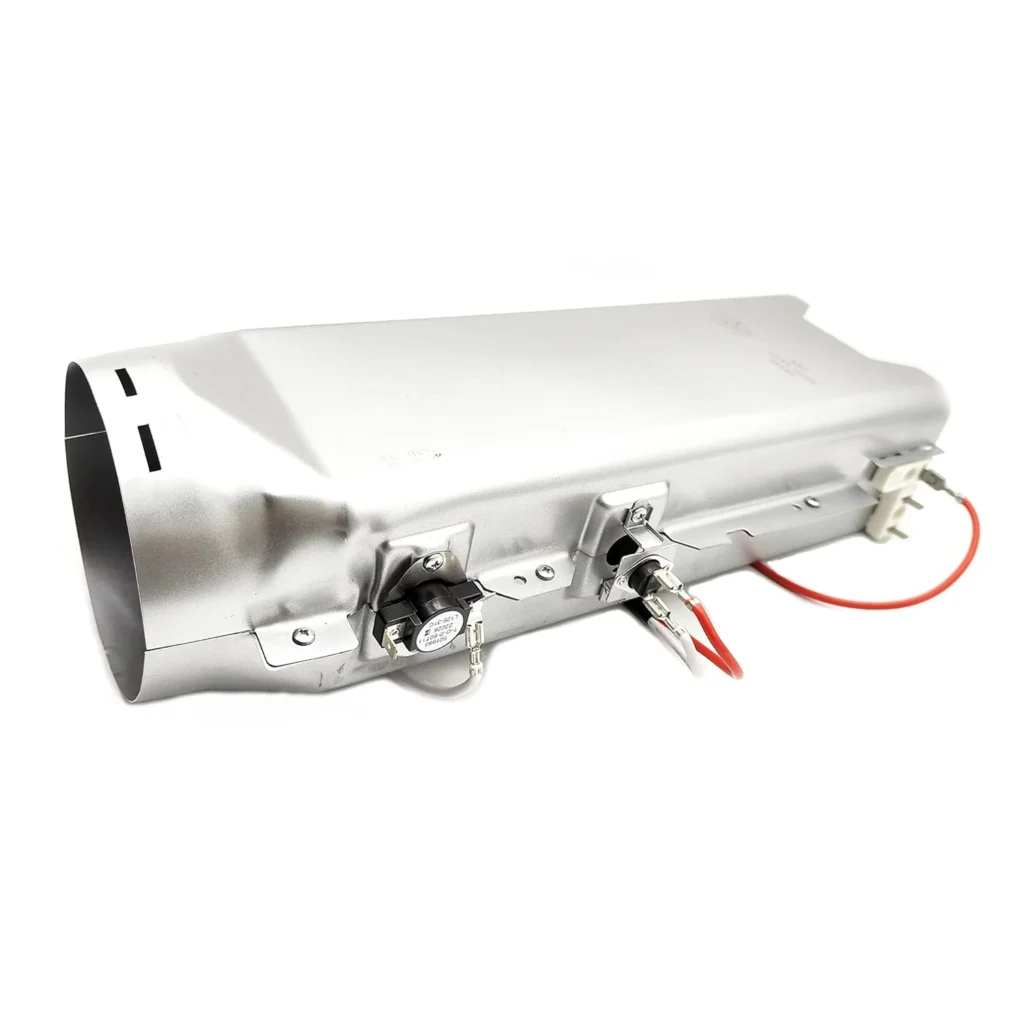
You toss a load of towels in your LG dryer, set it for 60 minutes, and come back to find them still damp and cold. The drum's spinning fine, the timer's counting down, but there's zero heat coming from that machine. Before you start shopping for a new dryer, let's walk through what's actually going wrong — because in most cases, it's one of five fixable problems.
Quick Symptom Check
Your LG dryer shows these specific symptoms when the heating system fails:
- Drum spins normally — motor's working, but no warmth at all
- Clothes come out damp after a full cycle, even on high heat
- Cycle completes on time — timer isn't the issue
- No burning smell — just cold air circulating
- Takes 2-3 cycles to dry what used to take one
If you're nodding along to three or more of these, keep reading. We'll go from most likely to least likely causes.
Cause #1: Failed Heater Assembly (60% of Cases)
The heating assembly in LG dryers like the DLE5977W, DLE7177WM, and DLE2512W does the heavy lifting. It's a coiled element housed in a metal chamber that heats air before it enters the drum. After a few thousand cycles, these coils burn out from thermal stress — just like a light bulb filament eventually fails.
How to diagnose: Unplug the dryer and access the heater assembly (it's typically behind the front lower panel or rear panel, depending on your model). You're looking for part number 5301EL1001A or its alternates AP4438941, 5301EL1001E, 5301EL1001G. Use a multimeter set to resistance mode. Touch the probes to the element terminals. You should see 8-12 ohms of resistance. If it reads infinite (OL on digital meters) or zero, the element's shot.
The fix: Replace the entire heating assembly. This isn't a repair job — you can't patch a broken heating coil. The assembly runs about $117 and takes 45 minutes to swap out if you're methodical. Disconnect wires (take a photo first), remove mounting screws, pull the old assembly, reverse the process with the new one.
Cost: $117 for the part, $0-180 if you hire out
Cause #2: Blown Thermal Fuse (25% of Cases)
Here's the thing about LG dryers — they're designed with multiple safety cutoffs to prevent fires. The thermal fuse is a one-shot device that blows permanently if the dryer overheats past 280°F. Once it's blown, it cuts power to the heating circuit completely. Your dryer will still run, still tumble, but it'll never heat again until you replace that fuse.
Why it blows: Usually from restricted airflow. A clogged lint filter, crushed vent hose, or bird's nest in your exterior vent will cause back-pressure. The dryer can't exhaust hot air fast enough, temperature spikes, fuse pops.
How to diagnose: The thermal fuse is mounted on or near the blower housing (varies by model — check DLE8377NM vs. DLE3777W for location differences). Pull it off and test continuity with a multimeter. Should read zero ohms (continuous connection). If it reads infinite, it's blown.
The fix: Replace the fuse AND fix whatever caused it to blow in the first place. I can't stress this enough — if you just swap the fuse without cleaning your vent system, you'll blow the new one within weeks. Clean the entire vent run from dryer to exterior, replace any crushed sections, make sure the exterior flapper opens freely.
Cost: $8-15 for the fuse alone
Cause #3: Faulty High-Limit Thermostat (10% of Cases)
This is another safety device, but unlike the thermal fuse, the high-limit thermostat is resettable. It's supposed to cycle the heating element on and off to maintain safe operating temperature. When it fails in the open position, it breaks the heating circuit just like a blown fuse would.
How to diagnose: Found near the heating assembly or blower housing. Test it at room temperature with a multimeter — should show continuity (zero ohms). If it's open at room temp, it's stuck and needs replacement.
The fix: Straightforward swap. These mount with a single screw or clip and have two wire terminals. Costs $10-20 for the part.
Cause #4: Bad Cycling Thermostat (3% of Cases)
The cycling thermostat works with your heat settings (low, medium, high) to regulate element temperature during normal operation. When it fails, it typically fails open — meaning it tells the control board to shut off heat and never turn it back on.
How to diagnose: This one's trickier because it needs to be tested under operating conditions. If you've already ruled out the heating element, thermal fuse, and high-limit thermostat, and you're handy with a multimeter, you can test this while the dryer's running (carefully, with proper safety precautions). It should cycle between open and closed as the dryer heats and cools.
The fix: Replace it. Mounted on the blower housing, usually $15-25.
Cause #5: Control Board or Wiring Issue (2% of Cases)
Least common, but possible. The main control board sends power to the heating circuit based on your selected settings. If it's not sending that signal, nothing heats up. Similarly, a burned wire or loose connection anywhere in the heating circuit will cause a no-heat condition.
How to diagnose: If you've tested everything above and it all checks out, you're looking at either the control board or a wiring fault. Trace the wire harness from the control board to the heating assembly. Look for burned, frayed, or disconnected wires. Check connector terminals for corrosion or looseness.
The fix: Repair or replace damaged wiring. Control board replacement on LG dryers runs $150-250 for the part and requires reconfiguring settings.
When to Call a Pro
Look, I'll be straight with you. If you're comfortable with a screwdriver, a multimeter, and following a diagram, the heater assembly replacement is totally DIY-able on models like the DLE5977W or DLE7177RM. You'll save $180 in labor.
But call a tech if:
- You're working with gas dryer lines (this article assumes electric)
- Testing reveals multiple failed components — might indicate a bigger electrical problem
- You've replaced the obvious parts and it still won't heat
- The control board is suspected (diagnostic complexity jumps way up)
Frequently Asked Questions
Why does my LG dryer take so long to dry but eventually works?
That's classic weak heating element behavior — not fully failed, but degraded. The coil has developed high resistance from age and corrosion, so it's producing maybe 30-50% of its rated heat output. Clothes will eventually dry, but it takes 2-3 cycles. Test the element resistance; if it's above 15 ohms, replace it even though it's technically still "working."
Can I test the heating assembly without a multimeter?
Sort of. You can do a visual inspection for obvious breaks in the coil — look for gaps or burn marks. But a heater element can look perfect and still be electrically failed. A $15 multimeter from any hardware store will definitively tell you if it's good or bad. It's the right tool for this job.
How long should a dryer heating element last?
Average lifespan is 8-12 years with normal residential use. But if you run 2-3 loads daily, you might see failure around year 6-7. Heavy use, high heat settings, and poor venting all shorten element life. Models like the DLE5932W or DLE6942W with higher capacity tend to cycle their elements more frequently.
Diagnosed the problem?
5301EL1001A · In Stock · Fast shipping