
LG Washer Drum Won't Spin But Motor Runs — 5 Causes & How to Fix
You start a load of laundry, and you hear the motor humming away like it's supposed to. But when you check back thirty minutes later, your clothes are sitting in soapy water and the drum hasn't budged an inch. The motor's clearly running — you can hear it — but nothing's actually spinning.
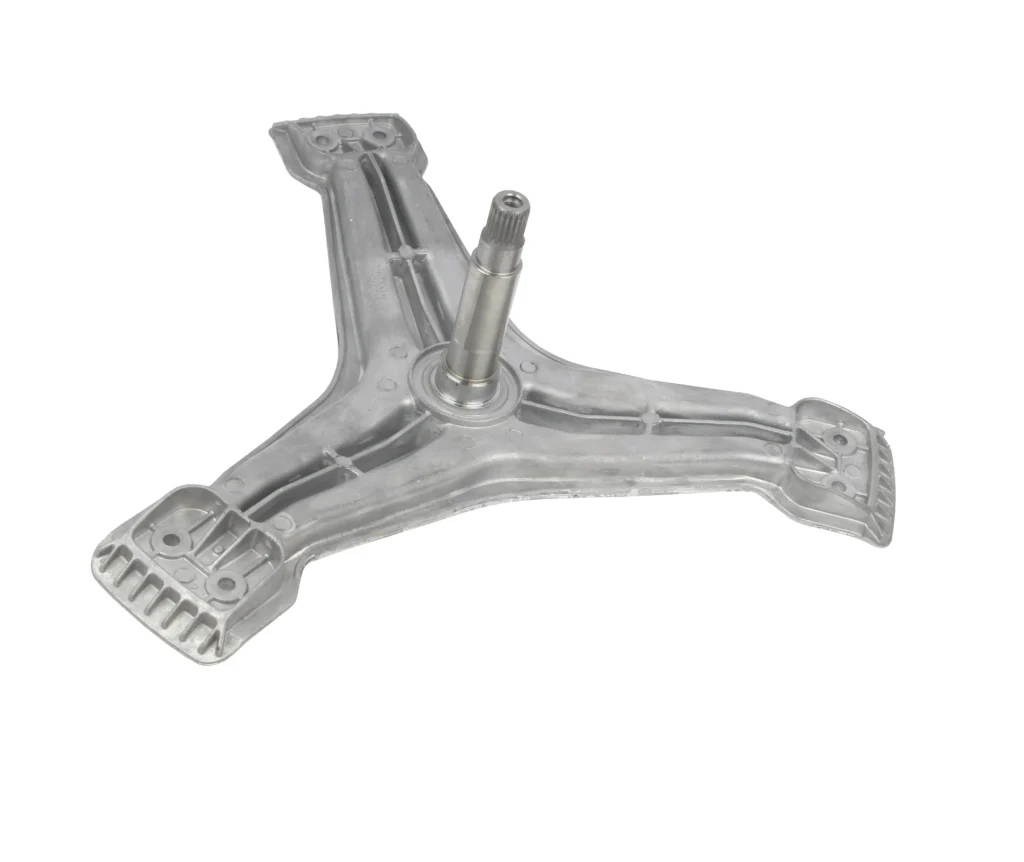
This disconnect between a running motor and a stationary drum points to a mechanical failure somewhere in the drive system. On LG front-loaders like the WM2050CW, WM2233HD, WM2688HWM, and WM3001HPA, the rear drum spider (part #4434ER0002D) is one of the most common culprits. When this component fails, it's dramatic — and it usually doesn't fail alone.
Quick Symptom Check
Before you start disassembling anything, confirm you're dealing with a mechanical failure rather than an electrical one:
- Motor runs but drum doesn't move — You hear the motor engaging, but zero drum movement
- Burning smell during wash cycle — Acrid, distinct odor that smells like overheated metal or rubber
- Excessive shaking and moving — Machine vibrates violently during what should be normal operation
- Grinding or scraping noises — Metal-on-metal sounds coming from inside the drum area
- Water leaking from underneath — Often accompanies spider or bearing failure
If you're experiencing two or more of these symptoms together, you're almost certainly looking at a failed spider assembly or bearing.
Cause #1: Corroded or Broken Drum Spider (Most Likely — 60% Probability)
The drum spider is a three-armed aluminum casting that connects the stainless steel wash drum to the bearing shaft. It's what actually transfers the motor's rotational force to the drum. On LG washers built between 2008 and 2016, these spiders have an unfortunate tendency to corrode from the inside out.
Why it happens: The spider is made of aluminum alloy, and when it's constantly exposed to moisture, detergent residue, and varying pH levels, galvanic corrosion eats away at the metal. The arms become brittle, develop cracks, and eventually snap completely. When this happens, the motor spins the shaft, but the drum just sits there because there's no longer a solid connection.
How to diagnose:
- Unplug the washer and turn off water supply
- Remove the top and front panels to access the drum
- Manually rotate the drum by hand — if it moves freely with no resistance, the spider has likely separated from the shaft
- Check for rust-colored water or aluminum powder around the bearing housing
- If you can access the spider arms through the drum holes, look for visible cracks or complete breaks
The fix: Unfortunately, this isn't a repair you can patch. You'll need to replace the drum spider (4434ER0002D) along with the tub bearing and seals. This is a major disassembly job that requires removing the entire drum assembly from the machine. Budget 3–4 hours if you're experienced, longer if it's your first time.
Parts needed: Drum spider assembly (4434ER0002D), outer tub bearing, bearing seal kit, and it's worth replacing the rotor position sensor while you're in there.
Cause #2: Failed Outer Tub Bearing (25% Probability)
The tub bearing sits in the center of the outer tub and allows the drum shaft to spin smoothly. When it fails, it creates enough friction that the motor can't overcome the resistance — or the bearing seizes completely.
Why it happens: Bearing seals deteriorate over time, allowing water and detergent to contaminate the bearing. Once moisture gets in, the steel balls and races corrode and pit. Eventually, the bearing either seizes or creates so much drag that the motor can't turn it.
How to diagnose:
- Try manually rotating the drum — it should spin smoothly with minimal effort
- If it feels gritty, catches, or requires significant force to turn, the bearing is compromised
- Listen for grinding, rumbling, or squealing during spin attempts
- Check for water leaking from the bearing housing area
The fix: Bearing replacement requires nearly complete disassembly — you'll already be replacing it when you replace the spider, since they typically fail together. On LG washers, the bearing is pressed into the outer tub, so you'll need a bearing installation tool or a local appliance repair shop to press it in properly.
Cause #3: Worn Drive Belt or Pulley (8% Probability)
Some LG models use a belt-driven system rather than direct drive. If your model has a belt (check your specific model number), a stretched, cracked, or broken belt will prevent power transfer from motor to drum.
How to diagnose:
- Access the rear panel or bottom of the washer
- Locate the drive belt connecting motor pulley to drum pulley
- Check for cracks, glazing, or complete breaks
- Ensure belt tension is adequate — should have about 1/2 inch of deflection when pressed
The fix: Belt replacement is straightforward if your model uses one. Release tension, slip the old belt off, route the new belt around both pulleys, and restore tension. This is a 30-minute job at most.
Cause #4: Faulty Stator Assembly (5% Probability)
LG direct-drive washers use a stator (stationary electromagnets) and rotor (permanent magnets attached to the drum) instead of a traditional motor and belt. If the stator windings fail, the magnetic field won't be strong enough to turn the rotor under load.
How to diagnose:
- Access the stator by removing the rear panel
- Visually inspect for burn marks, melted insulation, or obvious damage
- Use a multimeter to test resistance between stator coil terminals
- Check rotor magnets for damage or demagnetization
The fix: Stator replacement is moderately complex but doable. You'll need to disconnect the wire harness, remove mounting bolts, and install the new stator ensuring proper alignment with the rotor magnets.
Cause #5: Broken Rotor Position Sensor (2% Probability)
The rotor position sensor (Hall sensor) tells the control board exactly where the rotor is positioned so it can properly energize the stator coils. If this sensor fails, the motor may attempt to run but won't generate enough torque to actually spin the drum.
How to diagnose:
- Error codes — look for LE, LE1, or similar motor-related codes
- Motor hums but doesn't develop torque
- Test sensor output with a multimeter while manually rotating the drum
The fix: Sensor replacement is relatively simple once you access the stator assembly. Unplug the old sensor, plug in the new one, and secure it properly.
When to Call a Pro
Here's my honest take: if you're dealing with a failed spider or bearing on an LG washer that's more than eight years old, seriously consider replacement rather than repair. The labor for this job is extensive — we're talking about a near-complete teardown — and the parts alone will run you $150–$250.
A professional repair will cost $400–$600 depending on your market. A new mid-range washer starts around $600–$800. If your machine is older and has other age-related issues (control board glitches, door latch problems, worn suspension), you're probably better off putting that money toward a new machine.
That said, if your washer is only 3–5 years old and otherwise in good shape, this repair absolutely makes sense. The spider and bearing should last another 5–8 years once replaced.
Call a pro if:
- You're not comfortable with major disassembly projects
- You don't have a bearing press or access to one
- The outer tub is cracked (requires tub replacement, not economical)
- You're finding multiple issues as you disassemble
Frequently Asked Questions
Can I still use my LG washer if the drum won't spin but the motor runs?
No, don't attempt it. Running the machine in this condition will damage the motor, stator, and control board as they try to compensate for the mechanical failure. You'll turn a $200 spider repair into a $600+ multi-component disaster. Shut it down and diagnose the problem before running it again.
How long do LG drum spiders typically last?
It varies wildly based on water hardness, detergent type, and usage patterns. In ideal conditions with soft water and proper HE detergent, they should last 10–15 years. In reality, LG spiders from certain production years (2008–2016 especially) commonly fail at 5–8 years due to metallurgy issues. Models like the WM2277HW, WM2688HWM, and WM3001HPA series are particularly prone to early spider failure.
Is it worth replacing the spider on an older LG washer?
If the machine is less than 8 years old and you're doing the work yourself, yes — you'll spend $150–$250 in parts and get another 5–8 years of life. If you're paying a pro and the machine is over 10 years old, the math usually favors replacement unless you have a high-end model that originally cost $1,200+. Factor in that you'll likely need to address other aging components soon anyway.
Diagnosed the problem?
4434ER0002D · In Stock · Fast shipping