
GE Refrigerator Not Defrosting — 5 Causes & How to Fix
You open your GE side-by-side and find a glacier forming on the back wall of the freezer. Ice cream's rock-hard, bags of vegetables are frost-welded together, and there's a suspicious puddle under the crisper drawers. Your refrigerator isn't defrosting like it should — and that frost buildup is just the beginning of your problems.
When the automatic defrost system fails on models like the GSS20IETAWW or HSS22GFTGWW, ice accumulates on the evaporator coils. This blocks airflow between the freezer and fridge sections, making both compartments run warmer than they should. Your compressor runs constantly trying to compensate, your energy bill climbs, and eventually food starts spoiling.
Most defrost failures trace back to five specific components. Here's how to identify which one failed in your unit.
Quick Symptom Check
- Thick frost buildup on freezer back wall or evaporator coils
- Freezer section running too warm despite compressor running
- Fridge compartment too warm (40°F or higher)
- Water pooling under crisper drawers or on floor
- Compressor running constantly without cycling off
- Ice maker not making ice or producing hollow cubes
- Unusual noises from freezer (ice blocking fan)
Cause #1: Failed Defrost Heater (60% Probability)
The defrost heater is the most common culprit. It's supposed to cycle on every 8-10 hours to melt frost off the evaporator coils. When it burns out, frost accumulates cycle after cycle until it blocks all airflow.
How to diagnose: Unplug the fridge and access the evaporator cover in the freezer (usually behind a panel on the back wall). If you see thick ice covering metal coils, the defrost system isn't working. Use a multimeter to test the heater for continuity — you should get 15-30 ohms. Infinite resistance means it's dead.
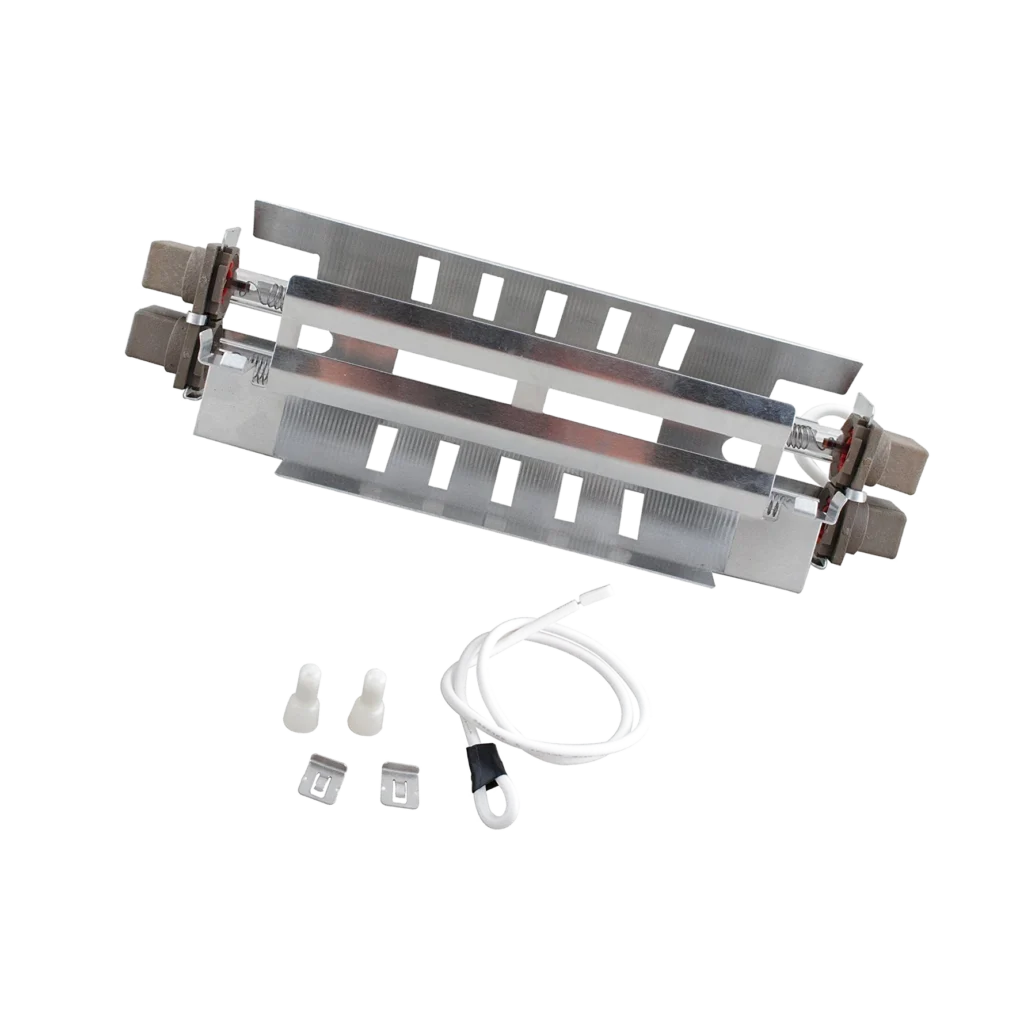
The WR51X10101 defrost heater kit fits over 200 GE, Hotpoint, and Kenmore models including the GSS22QFMC, TFX20JABGWW, and ESH22JFWAWW. It's a glass tube element that mounts beneath the evaporator coils.
The fix: Replacing the heater takes 45-60 minutes. You'll need to remove frozen food, unplug the unit, and remove the evaporator cover. Disconnect the wire harness, remove mounting clips, install the new heater, and reassemble. Expect to pay $52-$85 if you do it yourself, $200-$300 with a service call.
Cause #2: Defrost Timer Stuck (20% Probability)
The defrost timer controls when the heater cycles on. It's usually located behind the kickplate or in the control panel. When it fails, it either never advances to the defrost cycle (causing frost buildup) or gets stuck in defrost mode (making the freezer too warm).
How to diagnose: Locate the timer — it's a round or square component with a dial you can advance manually. Try advancing it with a screwdriver while listening for a click. Wait 30 minutes. If the compressor doesn't shut off and you don't hear water dripping, the timer isn't triggering defrost even when manually advanced.
The fix: Timers cost $25-$60 and take 20 minutes to replace. They're usually held by a single mounting bracket and plug-in connectors. No soldering required.
Cause #3: Faulty Defrost Thermostat (15% Probability)
The defrost thermostat is a safety device mounted directly on the evaporator coils. It tells the heater when the coils are cold enough to need defrosting and shuts it off when they reach about 50°F. When it fails closed, the heater never gets power. When it fails open, the heater runs constantly.
How to diagnose: It's a small component clipped to the evaporator coils, usually with two wire terminals. Test it with a multimeter when the coils are frozen — you should get continuity (0 ohms). If you get infinite resistance when coils are below 20°F, it's failed.
The fix: Thermostats run $12-$25. Replacement requires accessing the evaporator compartment, but the swap itself takes 10 minutes. Slide off the old one, clip on the new one, reconnect wires.
Cause #4: Bad Defrost Control Board (3% Probability)
Newer GE models use an electronic adaptive defrost control instead of a mechanical timer. It monitors compressor run time and door openings to determine optimal defrost frequency. When the board fails, the defrost cycle never initiates.
How to diagnose: This requires some electrical knowledge. Check for error codes on the display (if equipped). Test voltage output to the heater during what should be a defrost cycle. No voltage output = bad board.
The fix: Control boards cost $80-$150 and require careful wire-by-wire transfer from old to new. Not a beginner-friendly repair. Budget 45 minutes if you're experienced.
Cause #5: Defrost Heater Fuse Blown (2% Probability)
Some GE refrigerators have a thermal fuse in series with the defrost heater. It's a one-time safety device that blows if the heater overheats. Once blown, it must be replaced — it won't reset.
How to diagnose: It's a small component (looks like a resistor) with two wires, usually located near the heater. Test for continuity with a multimeter. No continuity = blown fuse.
The fix: Fuses cost $8-$15. They're held by spring clips or wire connections. Takes 5 minutes to replace, but you need to access the evaporator compartment. Important: If the fuse blew, figure out why. A shorted heater or failed thermostat can blow the fuse.
When to Call a Pro
DIY the defrost heater replacement if you're comfortable unplugging appliances, using a screwdriver, and following step-by-step instructions. The parts are straightforward, and you can't shock yourself if the fridge is unplugged.
Call a technician if:
- You're dealing with the electronic control board
- You smell burning plastic or see melted wiring
- The compressor isn't running at all (different problem)
- You've replaced the heater but frost returns within a week
- You're not comfortable defrosting and accessing the evaporator compartment
A sealed system leak (refrigerant issue) can mimic defrost problems but requires EPA-certified handling. If the compressor runs constantly but both compartments are warm and there's no frost buildup, suspect a leak rather than defrost failure.
Frequently Asked Questions
How long does it take for frost to build up if the defrost heater fails?
You'll see noticeable frost within 3-5 days. Heavy buildup that blocks airflow typically takes 2-3 weeks. If you catch it early, you can manually defrost (unplug for 24 hours with doors open) and replace the heater before food spoils.
Can I test if my defrost heater is working without a multimeter?
Yes, but it's less reliable. Manually advance the defrost timer or wait for a defrost cycle (check your model's manual for timing). Open the freezer and listen for sizzling sounds and watch for water dripping from the evaporator drain. If you see/hear nothing after 20 minutes, the heater likely isn't working. But a multimeter gives you certainty in 30 seconds.
Why does my GE refrigerator have frost buildup on one side only?
The defrost heater is the same length as the evaporator coils. If only one section has frost, you've got a partially failed heater — one end burned out while the other still works. Replace the entire heater assembly; you can't repair just part of it. The WR51X10101 kit includes the complete heater for your GE side-by-side.
Diagnosed the problem?
WR51X10101 · In Stock · Fast shipping