
Samsung Washer Won't Start or Unlock — 5 Lid Lock Causes & Fixes
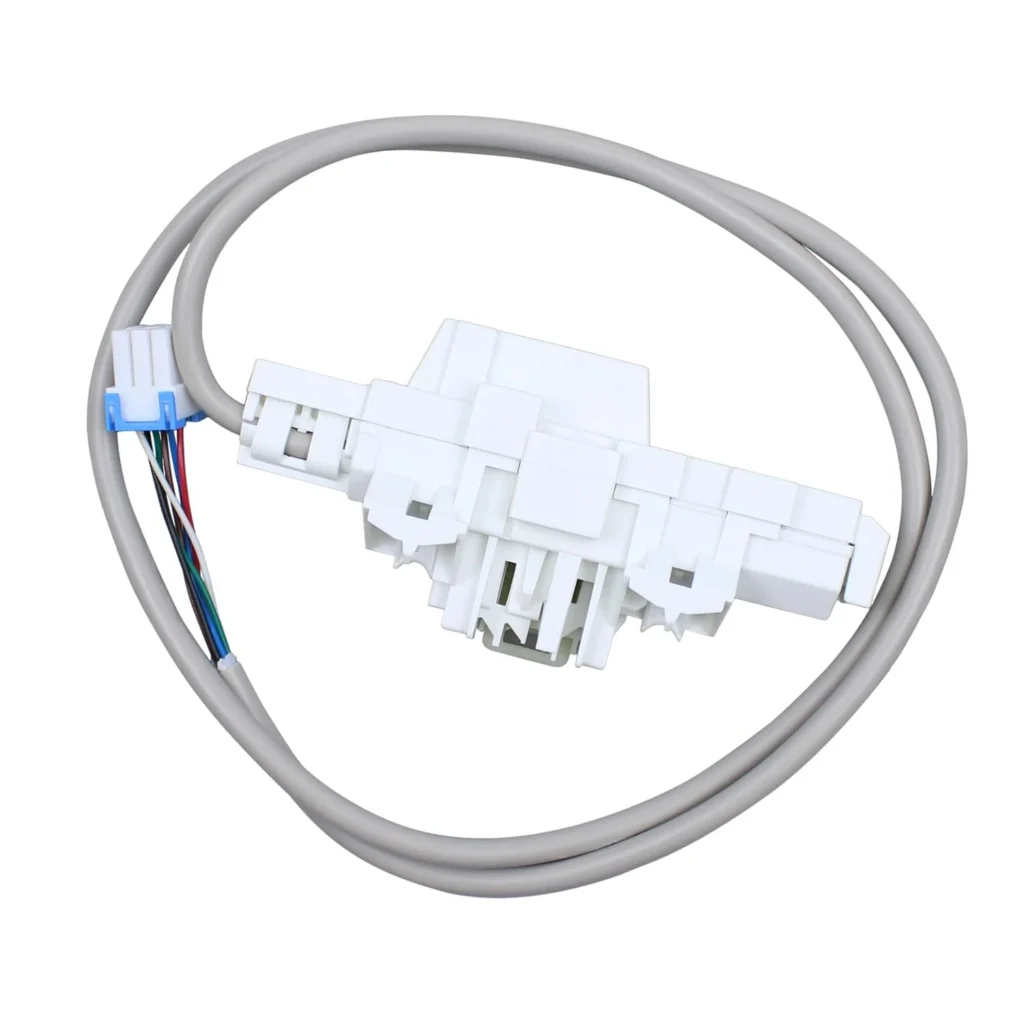
You loaded the washer, pressed start, and... nothing. The lid clicks but won't lock, or maybe it locked and now won't release your wet clothes. On Samsung top-loaders like the WA45H7000AW or WA45M7050AW, the lid lock assembly (part DC34-00025E) handles both mechanical locking and electrical signaling — when it fails, your washer becomes a $600 laundry basket.
The lid lock isn't just a safety feature. It's a critical component that tells the control board the lid is secure before allowing the spin cycle. When it malfunctions, you'll typically see error codes like DC, dE, or simply a washer that hums but won't fill.
Quick Symptom Check
Your Samsung washer has a lid lock problem if you're experiencing:
- Lid won't lock at all — clicks but doesn't engage, washer won't start
- Lid locked but won't unlock — cycle finished but lid stays locked, clothes trapped inside
- Error codes DC, dE, or door error — displayed on control panel with beeping
- Washer starts then immediately stops — fills briefly, drains, shows error
- Red lock light flashing — continuous blinking without locking
If you're seeing any of these, the problem is almost certainly in the lid lock assembly or its wiring harness.
Cause #1: Broken Lid Lock Mechanism (65% of Cases)
Probability: Very High
The plastic striker and latch inside the DC34-00025E assembly wear out from repeated use. On models like the WA40J3000AW and WA422PRHDWR, we see this fail around the 4-6 year mark. The striker that catches the lid hook cracks, or the solenoid that engages the lock burns out.
How to diagnose:
- Unplug the washer completely
- Open the top panel by removing two screws at the back
- Locate the lid lock assembly — it's the white plastic unit where the lid striker hits
- Manually press the striker mechanism — it should move smoothly and spring back
- Look for visible cracks in the white plastic housing
- Check if the metal striker piece is bent or broken off
If the mechanism feels loose, doesn't spring back, or has visible damage, that's your problem. This part experiences hundreds of lock cycles per year, and the plastic fatigues.
The fix: Replace the entire lid lock assembly. The DC34-00025E is the updated version that addresses the weak points in older models DC34-00025A and DC34-00025C. Cost is around $129, repair time is 30-45 minutes.
Cause #2: Failed Lid Lock Switch (20% of Cases)
Probability: High
Even when the mechanical lock works, the electrical switch that signals the control board can fail independently. This is common on the WA45H7200AW and WA45K7600AW series — the lock engages, you hear it click, but the washer still won't start because the switch isn't sending the "lid closed" signal.
How to diagnose:
- Unplug washer and access the lid lock assembly
- Disconnect the wire harness (usually 4-6 wires)
- Set multimeter to continuity or ohms setting
- Test between the switch terminals while manually engaging the lock
- You should see continuity when locked, open circuit when unlocked
- If readings don't change or are inconsistent, the switch is dead
The switch is integrated into the DC34-00025E assembly — you can't replace it separately. But this test confirms whether you're dealing with an electrical or mechanical failure.
The fix: Replace the complete lid lock assembly with DC34-00025E, which includes both the mechanical lock and the electrical switch.
Cause #3: Damaged Wiring Harness (10% of Cases)
Probability: Medium
The wire harness that connects the lid lock to the control board can get pinched when you close the top panel, or corrode from water dripping into the connection. This is especially common if you've had previous overflows.
How to diagnose:
- With washer unplugged, remove top panel
- Inspect the wire harness from lid lock to control board
- Look for: pinched wires, exposed copper, green corrosion on connector pins
- Wiggle the connector while watching for loose contacts
- Check continuity from lid lock connector pins to control board connector
If you find damaged wires but the lid lock assembly itself tests good, you can sometimes repair the harness with solder and heat shrink. But if the connector is corroded, replacement is safer.
The fix: If just the wires are damaged, repair them. If the connector on the lid lock is corroded, you'll need the new DC34-00025E assembly anyway since it comes with a fresh connector. Some techs splice in a new connector, but for $129, replacing the whole assembly eliminates multiple failure points.
Cause #4: Control Board Not Sending Power (3% of Cases)
Probability: Low
Rarely, the main control board fails to send the 120V signal to engage the lid lock solenoid. This happens more often on models WA45T3400AW and WA45N3050AW if there's been a power surge.
How to diagnose:
- Warning: This test involves live voltage — only proceed if you're comfortable working with electricity
- Plug in washer, don't start a cycle yet
- Remove top panel with washer plugged in (use extreme caution)
- Set multimeter to AC voltage
- Press start button to initiate a cycle
- Test voltage at the lid lock connector — should read 120V when washer attempts to lock
- If no voltage, control board is the problem
If you're not comfortable with live voltage testing, skip this and call a tech. But if you confirm no voltage is reaching the lid lock, you're looking at a control board replacement ($200-300).
The fix: Control board replacement requires matching the exact board version to your model. This is usually a job for a pro unless you're experienced with appliance electronics.
Cause #5: Lid Striker Misalignment (2% of Cases)
Probability: Very Low
Sometimes the problem isn't the lock at all — it's the metal striker on the lid that's supposed to engage the lock mechanism. If the lid hinges have loosened or the striker bent, the lid physically can't align with the lock.
How to diagnose:
- Close the lid slowly while watching the striker and lock alignment
- The metal striker should slide directly into the lock housing slot
- If it's hitting above, below, or to the side, that's your issue
- Check the lid hinge screws — they can loosen over time
The fix: Tighten lid hinge screws or slightly bend the striker (carefully) to realign. If the striker is broken off, you'll need a new lid assembly, but that's rare.
When to Call a Pro
This repair is DIY-friendly if you're comfortable with:
- Disconnecting and reconnecting wire harnesses
- Using a multimeter for basic continuity testing
- Removing screws and panels without forcing anything
Call a professional if:
- You've replaced the lid lock but still get error codes — points to control board
- You're seeing multiple error codes beyond just door/lid errors
- The washer is still under warranty (don't void it with DIY repairs)
- You're not comfortable testing live voltage
The DC34-00025E replacement itself is straightforward — four screws and one wire connector on most Samsung top-loaders. But if you're unsure about electrical testing or the problem persists after replacement, professional diagnosis can save you from throwing parts at the problem.
Frequently Asked Questions
How long does a Samsung washer lid lock last?
Typically 5-7 years with normal use, which translates to about 1,000-1,500 load cycles. Heavy users who run multiple loads daily may see failure around the 4-year mark. The DC34-00025E is an improved design over the original DC34-00025A that had a higher failure rate around 3 years.
Can I bypass the lid lock to use my washer temporarily?
No, and here's why you shouldn't try: The lid lock prevents the spin cycle from operating with the lid open, which would send clothes and water flying. Some online guides show ways to "trick" the sensor with magnets or wire jumpers — don't do this. It's dangerous, voids your warranty, and if someone gets hurt, you're liable. The DC34-00025E costs $129; an ER visit costs thousands.
Why does my lid lock work sometimes but not others?
Intermittent operation usually means the plastic striker mechanism inside the lock is cracked but not completely broken. It works when things align perfectly, fails when they don't. You might also have a corroded wire connector that makes contact sometimes. Both issues will get worse — it's not going to fix itself. Replace the lid lock assembly now before you're stuck with wet clothes locked inside during the next failure.
Diagnosed the problem?
DC34-00025E · In Stock · Fast shipping