
Whirlpool Washer Shaking Violently or Walking Across Floor — 5 Causes & How to Fix
You're running a load of towels when your Whirlpool front-loader starts sounding like a freight train. The entire machine is hopping across the laundry room floor, rattling the bottles on the shelf above. You hit pause, and suddenly it's quiet again. The spin cycle's become a nightmare, and you're wondering if something's seriously broken.
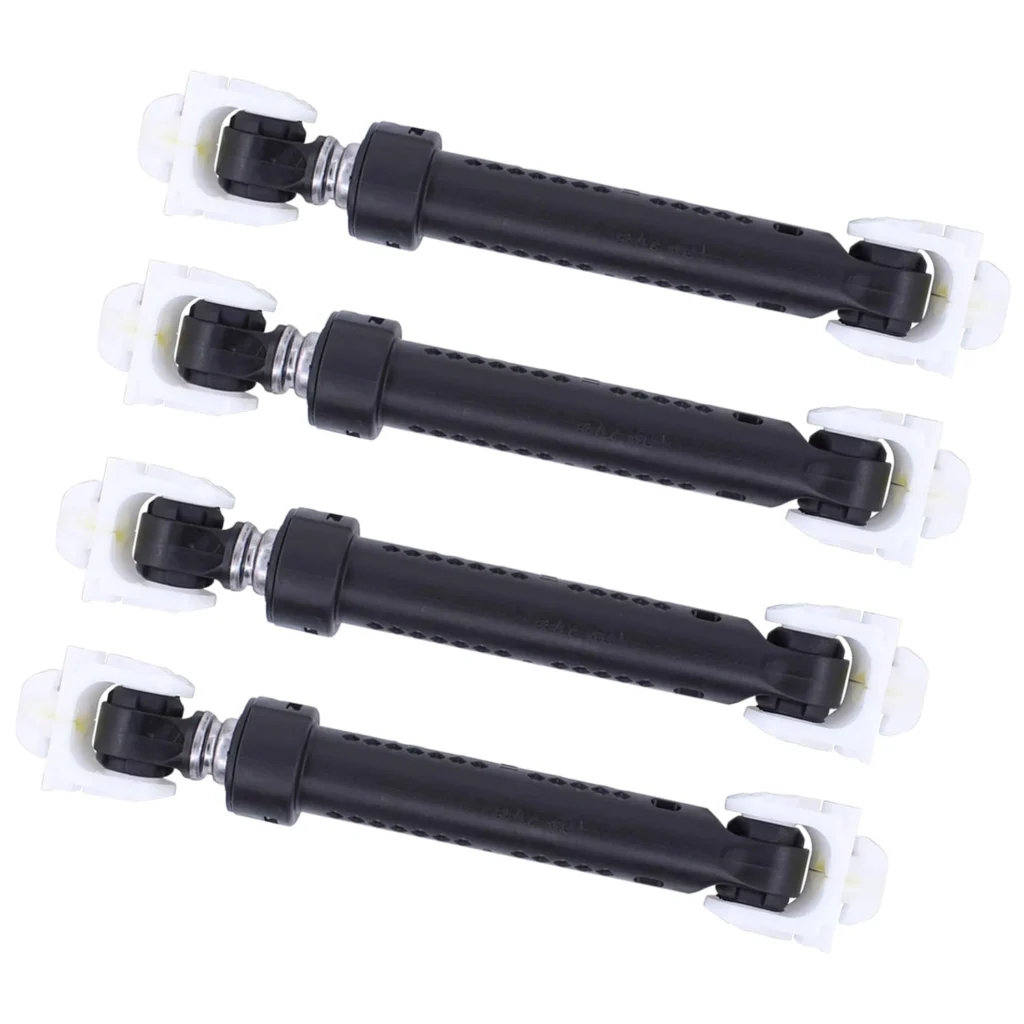
If your Whirlpool, Maytag, or KitchenAid washer is shaking violently during spin — especially high-speed spin — you're likely dealing with failed shock absorbers. These hydraulic dampeners (part 8182703 for many models like the GHW9150PW0, GHW9400PL0, or MHW6000XW2) are designed to keep the drum stable during the 1200+ RPM spin cycle. When they wear out, nothing stops the drum from banging around inside the cabinet.
Quick Symptom Check: Is It Really the Shock Absorbers?
- Violent shaking or banging during spin cycle only
- Washer "walks" across the floor during high-speed spin
- Loud banging noise when drum speeds up
- Normal operation during wash and rinse, chaos during spin
- Visible movement of the entire cabinet
- No error codes displayed (machine thinks it's working fine)
If you checked three or more, keep reading. The issue is almost always mechanical, not electronic.
Cause #1: Failed Shock Absorbers (Probability: 75%)
This is the big one. Front-load washers use four shock absorbers (part 8182703 for Whirlpool/Maytag) mounted between the outer tub and the base frame. They work exactly like car shocks — hydraulic fluid inside a cylinder dampens movement. After 8-10 years or 3,000+ cycles, the seals fail, fluid leaks out, and you've got metal rubbing on metal with zero dampening.
How to diagnose: Unplug the washer and tip it back against the wall (have someone help). Look at the four shock absorbers extending from the tub down to the base. Push the tub side-to-side. Healthy shocks should provide firm resistance. Failed shocks feel loose, may have visible oil residue, or the piston slides in and out with almost no resistance.
The fix: Replace all four shocks at once, not just the obviously bad one. They wear at similar rates, and mixing old with new creates an imbalanced dampening system. The 8182703 kit works with most Whirlpool, Maytag, KitchenAid, and Kenmore front-loaders from 2005-2018. You'll need to access the bottom of the machine (tip it back or lay it on its front), unbolt the old shocks, and bolt in the new ones. Budget 45-60 minutes if you're comfortable with basic tools.
Cost: $170-$200 for all four shocks if you DIY, $350-$450 with a service call.
Cause #2: Shipping Bolts Still Installed (Probability: 5%)
This applies mostly to recently moved or new machines, but it's worth checking because it's a 30-second fix. Front-load washers ship with four transit bolts that lock the drum in place during transport. If these aren't removed before first use, the drum can't float on its suspension system — it'll shake like crazy because it's essentially bolted solid to the cabinet.
How to diagnose: Look at the back panel of your washer. You'll see four large bolt holes, usually with plastic caps. If the bolts are still there (they're 3-4 inches long with thick plastic spacers), that's your problem.
The fix: Use a wrench to remove all four shipping bolts. Save them if you ever need to move the machine again. The washer should immediately stop the violent shaking.
Cost: Free.
Cause #3: Worn Suspension Springs (Probability: 12%)
The tub hangs from four heavy-duty suspension springs attached to the top of the cabinet. These springs work with the shock absorbers to isolate the spinning drum. If a spring breaks or stretches significantly, the tub sits lower on one side and becomes unbalanced during spin.
How to diagnose: Open the top panel (usually two screws at the back). With the machine off, visually inspect all four springs. Look for broken coils, excessive rust, or one spring that's noticeably longer than the others. Push down on different corners of the tub — it should return to center evenly.
The fix: Replace the broken or stretched spring. If one's bad, consider replacing all four for even tension. This requires removing the top and sometimes the front panel to access the spring attachment points.
Cost: $40-$60 for springs, $180-$250 with professional installation.
Cause #4: Unbalanced Load (Probability: 6%)
Before you assume it's a parts failure, rule out the simplest cause: load distribution. Modern front-loaders have sensors that detect imbalance and attempt to redistribute the load. But sometimes — especially with heavy items like comforters or bathmats — the machine can't correct it, and the mass shifts to one side during high-speed spin.
How to diagnose: Does the shaking happen with every load, or just certain ones? Try running an empty spin cycle. If the machine is smooth and quiet with no clothes, your shock absorbers are probably fine.
The fix: Redistribute the load manually. Don't wash a single heavy item alone — add a few towels to balance it out. If the machine shakes even when empty or with small balanced loads, it's not the load — move on to Cause #1.
Cost: Free.
Cause #5: Loose or Broken Tub Mounting Hardware (Probability: 2%)
The outer tub assembly bolts to the shock absorbers and hangs from the springs via metal brackets. If these bolts loosen over time (from vibration) or a bracket cracks, the tub won't be secured properly. This is rare but happens, especially if someone previously worked on the machine and didn't torque everything correctly.
How to diagnose: You'll need to access the tub mounting points (bottom and top of the machine). Look for loose bolts where the shock absorbers attach to the tub, or cracked plastic/metal mounting brackets. If you can wiggle the tub more than an inch in any direction with moderate force, something's loose.
The fix: Tighten all mounting bolts to manufacturer specs (usually 15-20 ft-lbs). If a bracket is cracked, you'll need to replace it — these are model-specific parts.
Cost: Varies widely depending on the part, $200-$350 with labor.
When to Call a Pro
Shock absorber replacement is a manageable DIY job if you're comfortable tipping a 200-pound appliance and working with basic hand tools. However, call a technician if:
- You're not comfortable handling the weight of the machine
- You've replaced the shocks and springs but the shaking continues (could indicate a damaged tub bearing or spider arm)
- The drum doesn't spin at all (different problem — likely a drive belt or motor issue)
- You hear grinding or scraping noises in addition to shaking (bearing failure, which is a much bigger repair)
A good technician will diagnose the issue in 15-20 minutes and have parts on the truck for common failures like shock absorbers.
Frequently Asked Questions
Do I need to replace all four shock absorbers at once?
Yes. Even if only one shock looks visibly failed, they all wear at the same rate. Mixing new and old shocks creates uneven dampening, which means the shaking problem will come back quickly. The 8182703 replacement is sold individually, so you'll need to order four units.
How long do washer shock absorbers typically last?
Most front-load shock absorbers last 8-12 years or around 3,000-4,000 wash cycles. If you run 6-8 loads per week, that's about 10 years. Heavy use, frequent overloading, or consistently washing bulky items can shorten their lifespan.
Will a shaking washer damage my floor or plumbing connections?
Absolutely. A violently shaking washer can crack tile, damage vinyl flooring, loosen water supply connections (causing leaks), and even pull the drain hose loose. Don't ignore the problem — continued use can turn a $200 shock absorber fix into a $500+ repair plus potential flood damage.
Diagnosed the problem?
8182703 · In Stock · Fast shipping