
GE Refrigerator Not Cooling or Running Loud — 5 Causes & How to Fix
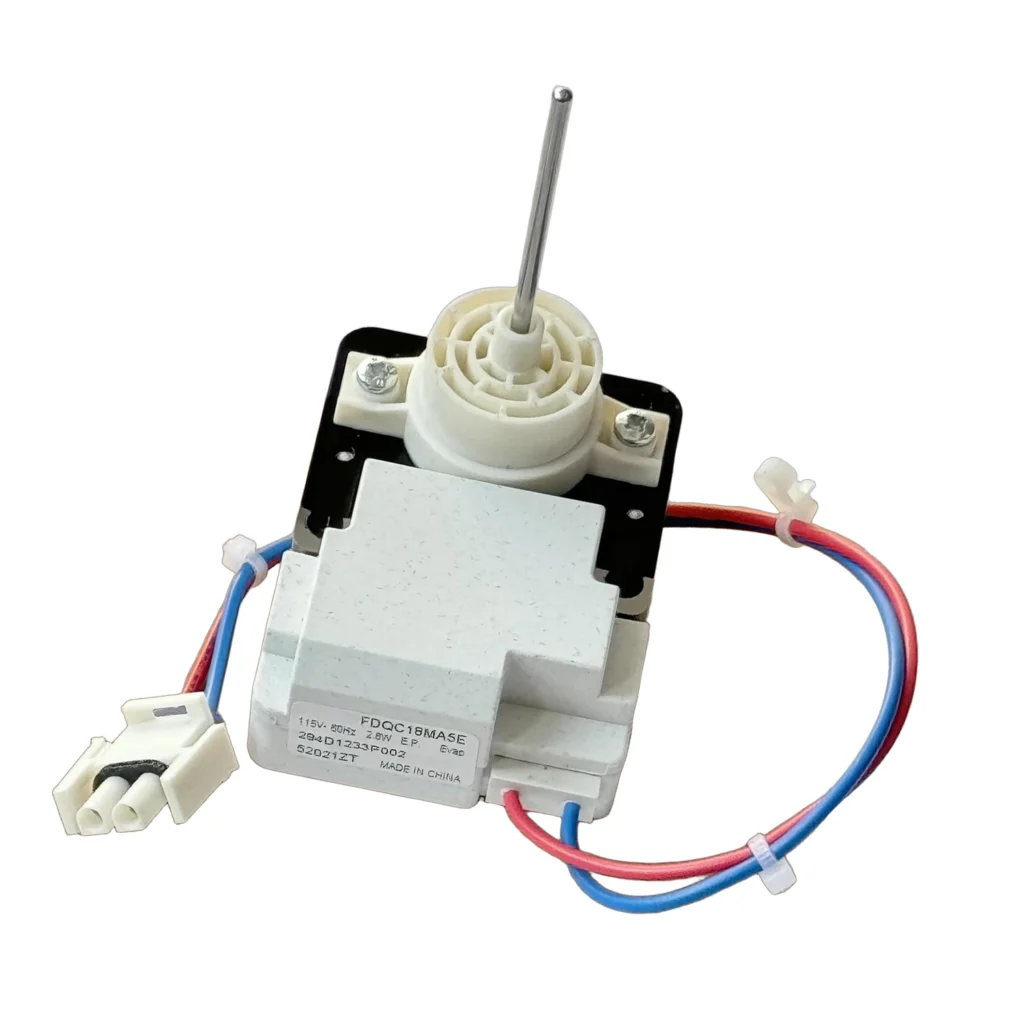
You open your GE refrigerator and the milk feels room temperature. The compressor's running, but there's either total silence where the condenser fan should be humming — or worse, a grinding noise that sounds like something's dying back there. If your GTS18FBSARWW or HTR17BBSA is suddenly struggling to keep temps below 45°F, the condenser fan motor (part 294D1233P002) is usually the culprit.
This motor pulls air across the condenser coils under or behind your fridge. When it fails, the compressor overheats, efficiency drops by 40-60%, and your food starts spoiling. Here's how to diagnose what's actually broken.
Quick Symptom Check
- Fridge compartment above 40°F but freezer works fine
- Compressor runs constantly but barely cools
- Grinding, buzzing, or clicking from the bottom/back panel
- Total silence where you should hear fan noise
- Condenser coils hot to touch after 10+ minutes of runtime
Cause #1: Failed Condenser Fan Motor (75% Probability)
The 294D1233P002 motor has sleeve bearings that wear out after 8-12 years of constant use. When they seize, the motor draws excessive current, trips internal protection, or just burns out completely.
How to test:
- Unplug the fridge and pull it away from the wall
- Remove the lower back panel (usually 4-6 screws)
- Locate the small fan near the compressor — it's about 3 inches across
- Try spinning the blade by hand. If it barely moves or feels gritty, bearings are shot
- If it spins freely, use a multimeter on the motor terminals — you should read 200-500 ohms
- Infinite resistance = open windings, motor's dead
Fix: Replace with 294D1233P002 (also replaces WR01F04574, 294D1978P001, WR01F04955). It's a direct swap — disconnect the wire harness, remove 2 mounting screws, pop the blade off the shaft, reverse the process. Takes 15 minutes once you've got the panel off.
Cause #2: Frozen or Obstructed Fan Blade (15% Probability)
If you've had a refrigerant leak or drain pan overflow, moisture can freeze around the fan blade. On models like the CTX18BACGRWW, dust bunnies sometimes jam into the blade housing.
Diagnosis: Remove the panel and visually inspect. If there's ice, you've got a separate drainage or defrost issue. If it's just dirt, clear it out and test-run the fan.
Fix: Thaw any ice with a hair dryer (fridge unplugged), clean debris, then address the root cause. If the fan motor still won't start after clearing obstructions, it's likely burned out from the stress.
Cause #3: Faulty Start Relay on Motor (5% Probability)
Some condenser fan motors use a small start capacitor or relay. If that component fails, the motor hums but won't spin.
Diagnosis: Listen closely when the compressor kicks on. If the fan motor hums for 3-5 seconds then stops, the relay's not engaging.
Fix: The 294D1233P002 motor is a direct-run design (no separate relay in most GE models), so this is rare. But if yours has an external relay, replace both components together.
Cause #4: Wiring Harness or Connector Corrosion (3% Probability)
The connector that plugs into the fan motor lives in a humid environment. After years of condensation exposure, the terminals oxidize and lose continuity.
Diagnosis: Wiggle the connector while the fridge is running (carefully — it's live voltage). If the fan starts intermittently, the connection's loose or corroded.
Fix: Clean terminals with electrical contact cleaner and a small wire brush. If the plastic housing is cracked, replace the pigtail connector (splice it in with heat-shrink butt connectors).
Cause #5: Main Control Board Not Sending Power (2% Probability)
The control board sends 120V to the condenser fan when the compressor runs. If that relay fails, the fan gets no power even though the motor's fine.
Diagnosis: Use a multimeter to check for voltage at the fan motor connector while the compressor's running. No voltage = board issue.
Fix: This is uncommon on mechanical-control GE models (like the TBX21NICBRWW), but electronic boards can fail. Replacement runs $150-300 for the board alone, so confirm the diagnosis thoroughly before ordering.
When to Call a Pro
If you're comfortable using a screwdriver and multimeter, replacing the condenser fan motor is straightforward. But call a tech if:
- You find refrigerant oil around the compressor (indicates a leak)
- The compressor itself won't start
- You're not confident working near live electrical components
- The fridge uses R600a refrigerant (some MABE models) — it's flammable
Most HVAC techs charge $180-250 for this repair (parts + labor). DIY costs $40-60 for the motor.
Frequently Asked Questions
How long should a GE condenser fan motor last?
Typically 10-15 years with normal use. Models in hot garages or dusty basements fail sooner because the motor works harder and accumulates more debris. The 294D1233P002 is a reliable replacement that fits dozens of GE and MABE models from 2005-2020.
Can I run the fridge without the condenser fan temporarily?
Only for a few hours in an emergency. The compressor will overheat and shut down on thermal protection. You risk permanent compressor damage if you run it for more than a day without the fan — that's a $600+ repair versus a $50 fan motor.
Why does my new condenser fan motor make noise?
If you just installed the 294D1233P002 and hear rattling, check that the fan blade is centered on the shaft and the mounting screws are tight. A slight hum for the first few hours is normal as bearings seat themselves. Grinding or clicking means something's installed wrong or the blade is hitting the housing.
Diagnosed the problem?
294D1233P002 · In Stock · Fast shipping