
LG Washer Won't Fill With Water or Start — 5 Causes & How to Fix
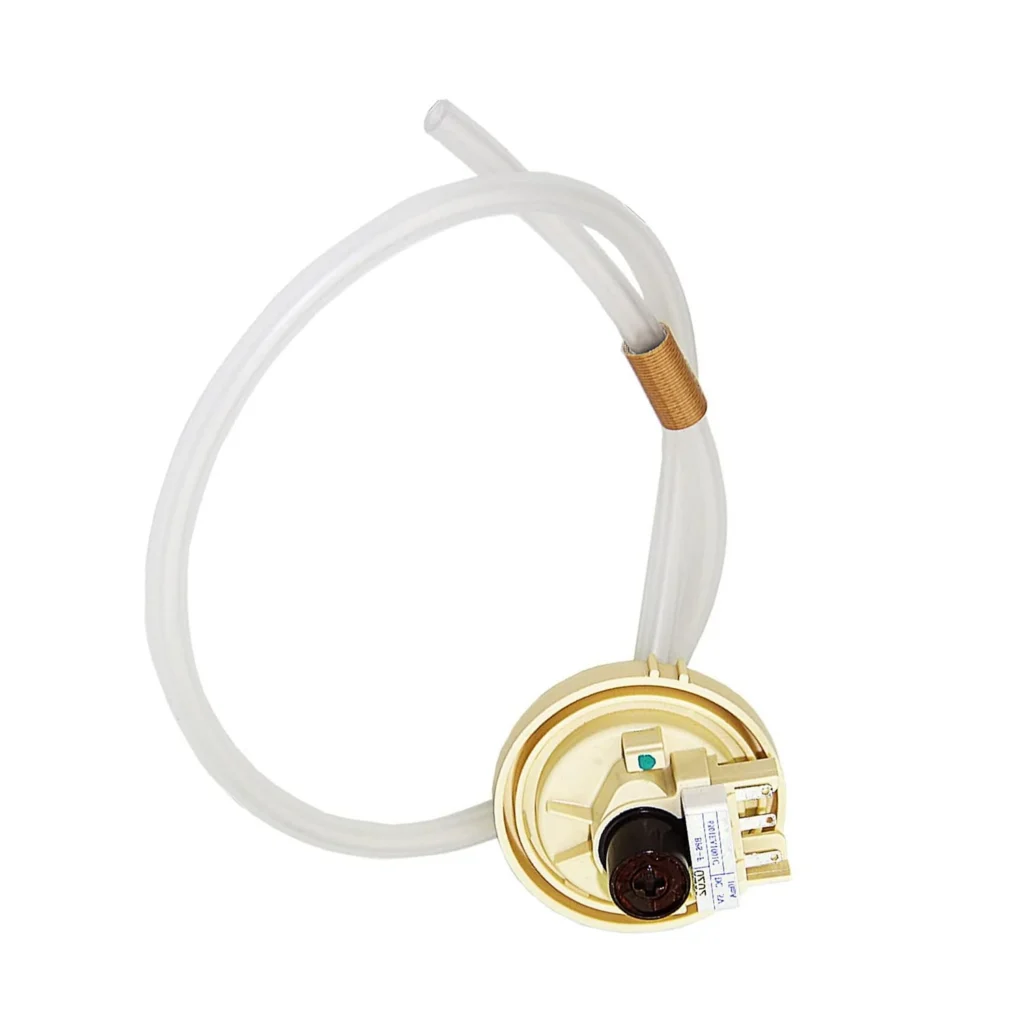
You load your laundry, hit start, and nothing. The drum sits there, bone dry. Or maybe you hear the cycle beginning, but five minutes later there's still no water in the tub. Your LG washer's pressure switch — the part that tells the machine when it has enough water — might be the culprit.
The 6501EA1001C pressure switch is one of those components that fails quietly until your washer becomes completely useless. It's a $50 part that can save you a $300 service call, but only if you catch it before you start chasing the wrong problem.
Quick Symptom Check
Before you pull anything apart, see if your washer matches these patterns:
- Won't start at all — control panel lights up, but pressing start does nothing
- Starts but doesn't fill — you hear the motor engage, drum might move slightly, but no water enters
- Fills too much or too little — water level is wildly inconsistent between loads
- Error codes — IE (water inlet error) or OE (drain error) appearing repeatedly
- Stops mid-cycle — fills partway, then shuts down completely
If you're seeing any combination of these on models like the WT5070CW, WT1101CW, or WT7500CW, the pressure switch is a strong suspect.
Cause #1: Failed Pressure Switch (70% Probability)
The pressure switch itself can fail electronically. There's a diaphragm inside that responds to air pressure from the water level, and when that diaphragm cracks or the contacts corrode, the switch sends wrong signals to the control board.
How to diagnose:
- Unplug the washer and pull it away from the wall
- Remove the top panel (two screws at the back)
- Locate the pressure switch on the right side — it's a round component with a thin air tube connected
- Disconnect the wire harness and air tube
- Use a multimeter set to continuity mode
- With no air pressure, you should read continuity between certain terminals (check your model's tech sheet)
- Blow gently into the air port — the switch should click and continuity should change
No click? No continuity change? The switch is dead. Part number 6501EA1001C is the direct replacement for models WT1201CV, WT1501CW, WT5170HW, and dozens more in the LG top-load lineup.
Difficulty: Easy. Two screws, two connections. 20 minutes if you've never done it before.
Cause #2: Clogged or Kinked Air Tube (15% Probability)
That thin tube running from the pressure switch down to the tub? It's supposed to carry air pressure that changes as water fills. If it's clogged with detergent residue, kinked behind the drum, or has even a pinhole leak, the switch never gets the correct pressure reading.
How to diagnose:
- With the top panel off, trace the air tube from the switch down to where it connects to the tub
- Disconnect it at both ends
- Blow through it — air should pass freely
- Look for kinks, especially where it routes behind the drum
- Check for soap buildup inside the tube (hold it up to light)
If it's clogged, you can try flushing it with warm water, but honestly? The tube costs $8 and takes two minutes to replace. Don't risk a partial clog causing problems later.
Cause #3: Water Inlet Valve Failure (10% Probability)
Sometimes the pressure switch is fine — it's just never getting water because the inlet valve is stuck closed. The switch waits for water that never comes, and eventually the control board times out and throws an error.
How to diagnose:
- Turn off water supply and unplug washer
- Access the inlet valve (usually behind the top rear panel)
- Check the screens inside the valve ports for debris
- Disconnect the valve and test with a multimeter — should read 500-1500 ohms
- If readings are way off or it's obviously clogged, replace it
This is more common if you have hard water or old plumbing. Sediment builds up and eventually blocks flow completely.
Cause #4: Control Board Misreading the Switch (3% Probability)
Less common, but possible: the pressure switch is working perfectly, but the control board isn't interpreting its signals correctly. This usually happens after a power surge or if water got into the control panel.
How to diagnose:
- Verify the pressure switch tests good (see Cause #1)
- Check the wire harness for corrosion or loose pins
- Look for burn marks or swollen capacitors on the control board
- If you have a volt-ohm meter and the tech sheet, you can test voltage at the switch connector during a fill cycle
Control board replacement is expensive ($150-$300), so triple-check everything else first. Don't throw parts at it hoping something works.
Cause #5: Drain Pump or Hose Blockage (2% Probability)
Here's a weird one: if your drain system is partially blocked, the washer might think it already has water in the tub (because it does — it just never drained from last time). The pressure switch reads pressure and tells the control board not to fill.
How to diagnose:
- Pull the washer out and tilt it back against the wall (get help — these are heavy)
- Look underneath at the drain pump and hoses
- Check for standing water in the sump area
- Remove the pump filter and look for socks, coins, or slime buildup
If you find standing water when the washer should be empty, you've got a drainage problem that's confusing the pressure switch.
When to Call a Pro
Look, most of this is DIY territory. The pressure switch itself is literally two screws and two connectors. But call a tech if:
- You've replaced the switch and air tube and it still won't fill
- You're seeing multiple error codes that don't make sense together
- There's water inside the control panel area
- The washer is still under warranty (don't void it for a $50 part)
On models like the WT5680HVA or WT6001HW, sometimes there are TSBs (technical service bulletins) about control board updates that a tech needs to flash. Check LG's site with your serial number before you start buying parts.
Frequently Asked Questions
Will the washer work at all with a bad pressure switch?
Usually no. The control board won't start a cycle if it can't verify water level. Some models might fill continuously (because the switch never tells it to stop), but most LG washers from the last 10 years will just refuse to start or will throw an IE error code within 8 minutes of trying.
Can I use 6501EA1001R instead of 6501EA1001C?
Yes, they're the same switch. The C and R designations just indicate different packaging or minor manufacturing revisions. You'll also see AP5204365, PS3529177, and EBF62754506 cross-referenced — all the same part. Just make sure your model number is on the compatibility list.
How long do these pressure switches usually last?
Most fail between 5-8 years. If you use a lot of liquid detergent or don't run cleaning cycles regularly, soap residue can gum up the air tube connection and shorten the switch lifespan. HE detergent and monthly cleaning cycles help, but eventually that diaphragm inside just fatigues from thousands of cycles.
Diagnosed the problem?
6501EA1001C · In Stock · Fast shipping